Most enterprise AI teams spend months evaluating which large language model to use and very little time deciding how to protect it. That gap shows up fast once an LLM is connected to real business data — customer records, internal documents, support tickets, financial systems. LLM security is the discipline that closes that gap. It covers the model itself, but also the application layer, the prompts users send, the data retrieved to answer them, the APIs that connect everything, and the tools the model is allowed to call. Securing the model alone leaves most of the actual attack surface untouched. This article walks through what LLM security means, the risks enterprises need to plan for, and the controls that make LLM deployments defensible.
What Is LLM Security?
LLM security is the practice of protecting large language models, their applications, APIs, data, prompts, and connected systems from security, privacy, and misuse risks. It combines traditional application security — authentication, access control, encryption, monitoring — with controls built specifically for risks that only exist because the interface is natural language: prompt injection, data leakage through generated text, unauthorized tool use, and manipulation of retrieved context.
A large language model on its own is a prediction engine. It becomes an enterprise system once it's wrapped in an application, given API access, connected to a knowledge base through retrieval-augmented generation (RAG), and allowed to call internal tools or trigger workflows. Each of those layers introduces its own risk. Prompts can carry attacker instructions. Retrieved documents can contain manipulated content. APIs can be abused for scraping or denial-of-service. Connected tools can be tricked into taking actions the user never authorized.
LLM security has to account for all of it — the model, the surrounding application, the data pipeline feeding it, and the systems it's permitted to touch.
Why Is LLM Security Important for Enterprises?
LLM security matters for enterprises because production AI systems routinely process the same sensitive data that traditional security programs were built to protect — customer PII, financial records, healthcare information, legal documents, and proprietary business knowledge. An LLM application that mishandles that data creates the same exposure as any other insecure system, with a few extra failure points unique to how language models work.
Enterprise LLM adoption tends to expand the attack surface faster than security teams can review it. A single chatbot might touch a CRM, a document repository, a support ticketing system, and a payments API. Every one of those integrations is a new place where sensitive information can leak, be accessed without authorization, or be manipulated by a malicious prompt. Employees also copy internal documents, contracts, and source code into AI tools without always knowing where that data goes or how long it's retained.
The data at risk typically includes customer information, financial details, healthcare records, legal and contractual documents, employee data, intellectual property, internal knowledge bases, confidential prompts, and API credentials embedded in application code. None of that is new to security teams — what's new is that a natural-language interface can be used to extract or manipulate it in ways privacy firewalls and traditional access controls weren't designed to catch.
How Does LLM Security Differ From Traditional Application Security?
LLM security differs from traditional application security because the primary input and output channel is unstructured natural language, which is far harder to validate, sanitize, and constrain than structured API calls or form fields. Traditional web applications accept predictable inputs through defined fields. LLM applications accept open-ended text, and that text can contain instructions the system was never designed to follow.
A few characteristics set LLM security apart:
- Non-deterministic outputs. The same prompt can produce different responses, which makes testing and guardrails harder to validate with simple pass/fail checks.
- Prompt injection and context manipulation. Instructions hidden in user input or in retrieved documents can override the application's intended behavior.
- RAG and tool calling. When a model retrieves documents or calls external tools, it inherits the trust level of whatever it pulls in, unless that content is explicitly validated.
- Agentic behavior. AI agents that can take multi-step actions — querying a database, sending an email, updating a record — turn a text-generation risk into an operational one.
- Third-party model and API providers. Enterprises often send data to an external provider's infrastructure, which introduces vendor risk on top of application risk.
- Training and fine-tuning data. Data used to fine-tune a model can leak back out in generated responses if it isn't handled carefully.
None of this replaces standard application security practices. It sits on top of them.
The Biggest LLM Security Risks
Prompt Injection
Prompt injection is an attack in which an attacker manipulates an LLM application into following unintended instructions, either through direct user input or through content the model retrieves from an external source. Direct prompt injection happens when someone types instructions straight into a chat interface, trying to override the system prompt or bypass restrictions. Indirect prompt injection is more dangerous for enterprises: a malicious instruction is embedded in a webpage, PDF, email, or database record that the LLM later retrieves and treats as trustworthy context.
For example, a customer support LLM that summarizes incoming emails could be manipulated by an email containing hidden text instructing it to forward internal data to an external address. If the application has tool-calling access to an email system, that instruction can turn into an actual action rather than just a bad response. Reducing this risk means treating all retrieved content as untrusted, separating system instructions from user and retrieved content, and restricting what actions a model can trigger without human confirmation.
Sensitive Data Leakage
Sensitive data leakage occurs when an LLM application exposes personal, financial, healthcare, or confidential business information through prompts, retrieved context, generated responses, or stored logs. This can happen when employees paste confidential documents into a prompt, when a RAG system retrieves records the requesting user shouldn't have access to, or when a model's output includes details it was never supposed to surface.
A legal team using an LLM to summarize contracts, for instance, could inadvertently expose privileged clauses to a shared tool if access controls aren't enforced at the document level. Reducing this risk requires data classification before information reaches the model, PII detection and redaction, encryption in transit and at rest, and strict retention limits on prompts and logs.
Jailbreak Attacks
A jailbreak is a technique used to bypass an LLM's built-in safety restrictions, typically by disguising a prohibited request as something benign — a hypothetical scenario, a role-play instruction, or a multi-step prompt designed to gradually erode the model's refusals. Jailbreaks target the model's own safeguards rather than the surrounding application, but the consequences land on the enterprise deploying it: generated content that violates policy, discloses restricted information, or damages brand trust. Layered controls — model-level safety training plus application-level content filtering — reduce the odds that a single jailbreak technique compromises the whole system.
Insecure LLM APIs
Insecure LLM APIs create risk when authentication, authorization, rate limiting, or monitoring controls are weak or missing on the endpoints connecting applications to models. API keys hardcoded into client-side code, missing rate limits that allow scraping or cost abuse, and a lack of logging on API calls are common gaps. Enterprises should treat LLM API endpoints the same way they treat any other production API: strong authentication, scoped authorization, key rotation, rate limiting, and continuous monitoring for abnormal usage patterns.
Model Theft and Model Extraction
Model theft, or model extraction, is the unauthorized replication of a proprietary model's behavior by systematically querying its API and using the responses to train a copycat model. For enterprises that have fine-tuned a model on proprietary data or built a differentiated AI product, this represents a direct intellectual property risk. Rate limiting, query pattern monitoring, and watermarking outputs are common mitigations, though no single control eliminates the risk entirely.
Data Poisoning
Data poisoning is the deliberate manipulation of training data, fine-tuning data, or a knowledge base so that a model produces incorrect, biased, or attacker-controlled outputs. This can target the original training data, a fine-tuning dataset, or — increasingly relevant for RAG systems — the source documents a model retrieves at query time. A poisoned knowledge base can cause a model to confidently surface false or manipulated information without any change to the model itself. Validating and controlling access to data sources feeding both training and retrieval pipelines is the core defense.
Excessive Agency
Excessive agency is the risk created when an AI application or agent has more access to databases, files, APIs, or internal systems than its actual task requires. An agent that can both read and write to a CRM, for example, is far more dangerous if compromised than one restricted to read-only access. Scoping permissions tightly to the minimum required for each task, and requiring human approval for high-impact actions, limits the blast radius when something goes wrong.
Insecure Output Handling
Insecure output handling happens when an application trusts and acts on LLM-generated content without validation — passing it directly into a database query, a command execution, or a rendered web page. Model output should be treated the same way any user-supplied input would be: validated, sanitized, and checked against policy before it's used downstream.
AI Supply Chain Risks
AI supply chain risk comes from the third-party models, libraries, plugins, datasets, and hosted services that an LLM application depends on. A vulnerability or policy change in any one of those dependencies can affect the security or availability of the whole application. Enterprises should track and periodically review every model provider, open-source library, and plugin integrated into an AI system, the same way they'd track dependencies in any other software supply chain.
RAG Security Risks
RAG security risk involves unauthorized retrieval, vector database exposure, or sensitive context leakage when a model pulls information from an external knowledge base to answer a query. If document-level access controls aren't enforced inside the retrieval layer, a user can end up seeing content they were never authorized to view, simply because the model retrieved it as supporting context. This deserves deeper treatment than fits here — see our dedicated guide on RAG security for retrieval-specific controls.
How Attackers Exploit LLMs
Beyond the risks above, a few additional attack patterns are worth knowing. Model inversion attempts to reconstruct training data by analyzing a model's outputs, which matters most for models fine-tuned on proprietary or regulated data. Adversarial attacks use specially crafted inputs to cause a model to misclassify or misbehave in ways that look normal to a human reviewer. Credential and secret theft happens when API keys, database credentials, or internal system tokens end up exposed through prompts, logs, or insecure application code. Tool abuse occurs when an attacker manipulates a model into misusing the tools it has access to — sending unintended emails, running unintended queries, or triggering unintended workflows. Most of these overlap with the risks already described; the point is that they rarely appear in isolation. A single indirect prompt injection can chain into tool abuse, which can chain into data leakage, in one uninterrupted sequence.
How to Secure an LLM
Securing an LLM deployment means applying controls at every layer it touches, not just at the model.
Identity and Access Control
Every user, service, and application component interacting with an LLM should authenticate individually, with authorization scoped to the least privilege necessary. Role-based access control should extend to what data a user's queries can retrieve and what actions an agent can take on their behalf — not just what interface they can log into.
Data Protection
Classify data before it reaches an LLM so sensitive categories get stricter handling. PII detection and redaction, anonymization where full data isn't required, and encryption in transit and at rest all reduce exposure if a prompt, response, or log is ever compromised.
Prompt and Input Security
Input validation and prompt filtering can catch known injection patterns before they reach the model. This isn't a complete defense against novel injection techniques, but combined with clear separation between system instructions and user content, it meaningfully raises the difficulty of a successful attack.
Output Security
Validate model output before it's displayed, stored, or acted on. Sensitive-data detection on generated responses, policy checks against prohibited content, and human review for any output that triggers a high-risk action are all practical controls that don't require slowing down normal use.
API Security
Treat every LLM API endpoint as production infrastructure: authenticate every call, manage and rotate keys properly, enforce rate limits, and monitor for abnormal usage that might indicate scraping, extraction attempts, or cost abuse.
Monitoring and Logging
Log prompts, responses, access patterns, and model usage so security teams can investigate incidents and spot anomalous behavior. This creates its own privacy consideration: logs containing full prompts and responses can themselves become a repository of sensitive data if retention and access controls aren't applied to them with the same rigor as the production system.
LLM Security Architecture
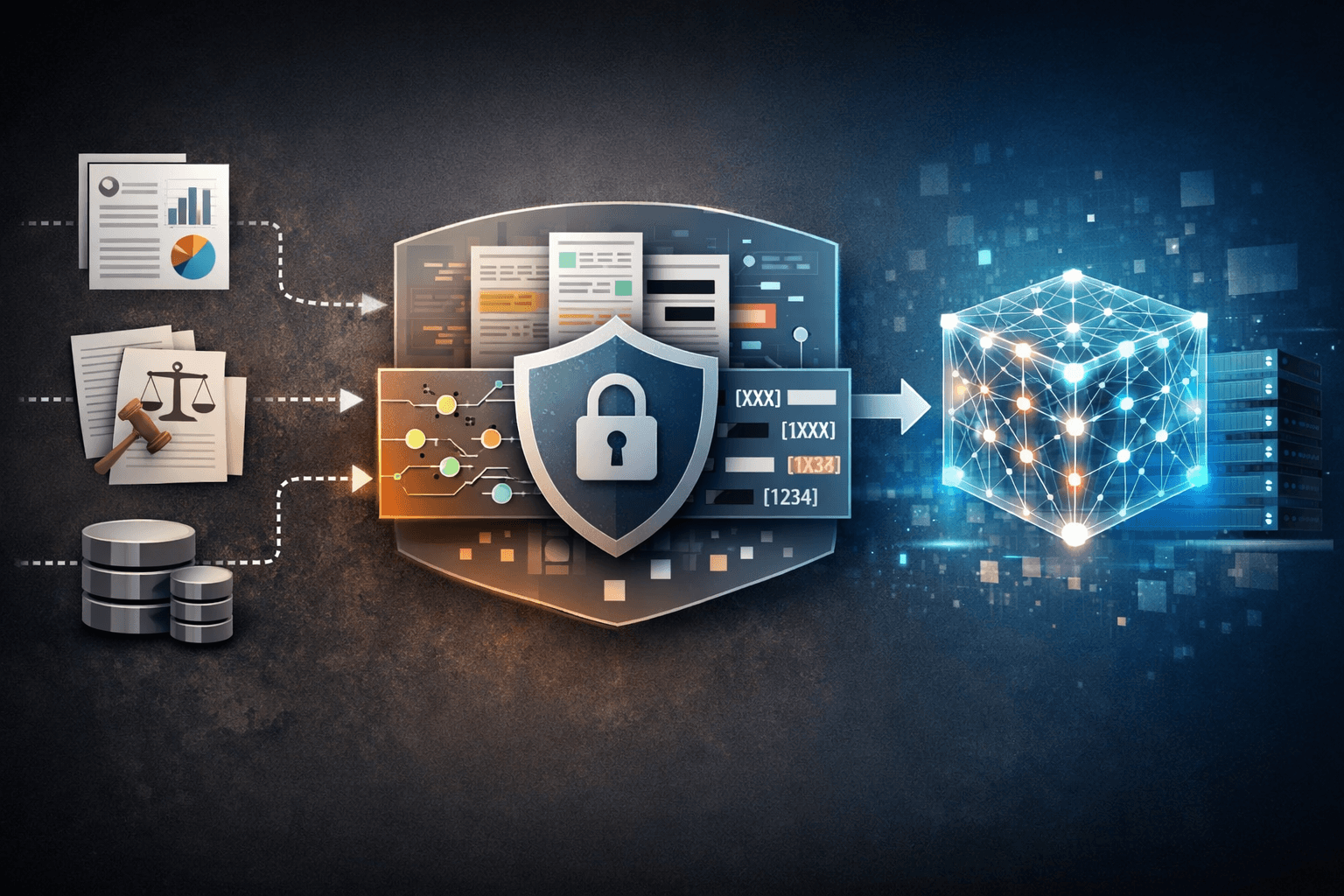
A practical enterprise LLM architecture generally looks like this: User → Application → Identity → Privacy/Security Controls → LLM/API → Retrieval/Data Layer → Tools → Monitoring/Audit.
Each layer protects something specific. Identity confirms who's making the request. Privacy and security controls sit between the user and the model to filter, redact, or block sensitive content before it's sent out and before responses come back. The LLM or API layer is where the actual inference happens, often at a third-party provider. The retrieval and data layer governs what documents or records the model can pull in, scoped to what the requesting user is authorized to see. The tools layer restricts what actions an agent can take. Monitoring and audit run across every layer, not just at the edges.
The important point: enterprises shouldn't rely solely on a model provider's built-in safety features. Those protect the model's behavior in general terms. They don't know your data classification policy, your access control model, or which of your internal tools should never be called without human review. That's the enterprise's responsibility to build.
LLM Security Best Practices
Enterprises that manage LLM risk well tend to apply the same set of practices consistently rather than treating security as a one-time review.
Start by classifying sensitive data before it ever reaches an LLM, so the application knows which categories require redaction, Data anonymization, or blocking outright. Apply least-privilege access everywhere — to users, service accounts, and agents alike — and extend that discipline to the tools an agent is permitted to call. Protect PII and confidential business information with detection and redaction at the point of entry, not after the fact.
Secure APIs the way you would any production system: authenticated, rate-limited, monitored, and reviewed regularly for unused or over-privileged keys. Build defenses against prompt injection into both the input layer and the retrieval layer, since indirect injection through retrieved documents is often harder to catch than direct attempts. Validate every model output before it's trusted downstream, and require human review for any action with real-world consequences.
Restrict tool and system access to what a given task actually needs. Secure RAG pipelines with document-level access control so retrieval never bypasses the permissions a user would have through any other system. Monitor LLM activity continuously, and treat those logs as sensitive data in their own right.
Protect credentials and secrets with the same rigor as any other system, since a leaked API key in a prompt or a config file is one of the simplest ways an LLM deployment gets compromised. Evaluate third-party AI providers on their data handling practices before integrating them, not after. Establish clear retention and deletion policies for prompts, logs, and generated content. Test AI applications continuously rather than once at launch, since new attack techniques against LLMs emerge regularly. Maintain incident-response procedures that specifically account for AI-related incidents — data leakage through a generated response looks different from a traditional breach and needs its own playbook. Review all of these controls on a recurring schedule, since the risk surface changes every time a new integration, tool, or model version is added.
LLM Security for Regulated Industries
Regulated industries face additional LLM security requirements because the data they process — financial records, health information, legal filings — is already subject to specific regulatory obligations that don't disappear just because an LLM is involved. Financial services and insurance firms need to account for data residency, auditability, and retention rules when routing customer data through an LLM. Healthcare organizations need controls that address patient privacy at every point data touches a model, including logs and cached responses. Legal organizations and government agencies typically require strict access control and audit trails for anything involving confidential or classified material. BPOs and SaaS companies handling customer data on behalf of clients often need to demonstrate, contractually, exactly how that data flows through any AI system they use.
Regulations like GDPR don't have an AI-specific carve-out — the same principles around lawful basis, data minimization, and individual rights apply whether data is processed by a traditional system or an LLM. No LLM deployment or vendor product is automatically compliant with GDPR or any other regulation; compliance depends on how the entire system — data flows, retention, access control, and documentation — is actually implemented and audited.
Building an LLM Security Framework
An LLM security framework is a structured, repeatable process enterprises use to identify, assess, and manage AI-specific risk across every application, rather than reviewing each deployment ad hoc. Building one typically starts with asset discovery — identifying every LLM application, API integration, and AI tool already in use across the organization, including ones adopted without formal review. From there, risk assessment and data classification determine which applications handle sensitive information and what level of control each one needs.
Threat modeling specific to LLM risks — prompt injection, data leakage, excessive agency — should follow, alongside standard identity, access, and privacy controls. Vendor and model assessment evaluates the providers behind each application against consistent criteria. Application security, monitoring, and testing round out ongoing operations, and incident response procedures should be updated to reflect AI-specific failure modes. None of this is a one-time project; it needs continuous review as new models, tools, and integrations get added.
LLM Security Testing
LLM security testing is the practice of systematically evaluating an AI application's resistance to prompt injection, jailbreaks, data leakage, unauthorized access, and other AI-specific attack techniques, in addition to standard application security testing. It differs from traditional application testing in one important way: LLM outputs are non-deterministic, so a single test case passing once doesn't guarantee it passes consistently. Effective testing needs to run repeatedly, across variations of the same attack, to get a reliable picture.
A thorough LLM security testing program covers prompt injection testing, jailbreak testing, data leakage testing, authorization testing (does the system respect access boundaries when retrieving data?), RAG retrieval testing, output validation, API abuse testing, and tool-use testing to confirm an agent can't be manipulated into taking unauthorized actions. Red-team exercises that simulate realistic attacker behavior, and regression testing after every model or prompt change, close the loop — a model update that improves performance can just as easily reintroduce a vulnerability that was previously fixed.
How to Evaluate an LLM Provider
Evaluating an LLM provider means asking specific questions about data handling, not just comparing model capability or pricing. Key areas to cover: Does the provider train on customer data by default, and can that be disabled? What are the data retention timelines for prompts and outputs? Where is data processed and stored, and does that meet your data residency requirements? Is data encrypted in transit and at rest? What authentication and access controls protect the API? What logging exists, and who can access those logs? Can data be deleted on request, and within what timeframe? Who are the subprocessors involved, and what compliance certifications does the provider hold? What's the incident response process if a breach occurs on the provider's side? Is customer data isolated from other tenants, or does it share infrastructure in ways that could create cross-tenant risk?
These questions matter as much for internal AI platform teams as for procurement. This is also where privacy-first approaches to enterprise AI, like the one Questa AI takes, tend to differ from general-purpose AI tooling — by building data minimization, access control, and retention limits into the deployment itself rather than leaving them entirely up to the underlying model provider's defaults. No platform, Questa AI included, removes the need for an enterprise to do its own risk assessment and provider evaluation.
Private AI and Data Privacy
Private AI refers to LLM deployments — whether self-hosted, on-premises, or run through a provider offering dedicated infrastructure — designed to keep enterprise data from being shared with or used to train third-party models. Public LLM APIs are usually the fastest way to get started, but they typically involve sending data to external infrastructure, which raises data residency and retention questions for sensitive information. Private and self-hosted models give enterprises more control over where data lives and how it's processed, at the cost of greater operational complexity and infrastructure investment.
The trade-offs are real in both directions. Public APIs offer faster deployment, lower upfront cost, and less operational overhead, but less direct control over data handling. Private and on-premises deployments offer more control and can simplify certain compliance requirements, but they demand more engineering resources and don't automatically guarantee better security — a poorly configured on-premises model can be just as exposed as a poorly configured API integration. Privacy layers such as anonymization, redaction, and data minimization applied before data reaches any model — public or private — reduce risk regardless of which deployment path an enterprise chooses. This is the layer where solutions Questa AI's privacy-first approach are designed to operate, applying data protection controls in front of whichever underlying model an enterprise chooses to use, rather than requiring a full move to self-hosted infrastructure to get meaningful privacy benefits.
Frequently Asked Questions