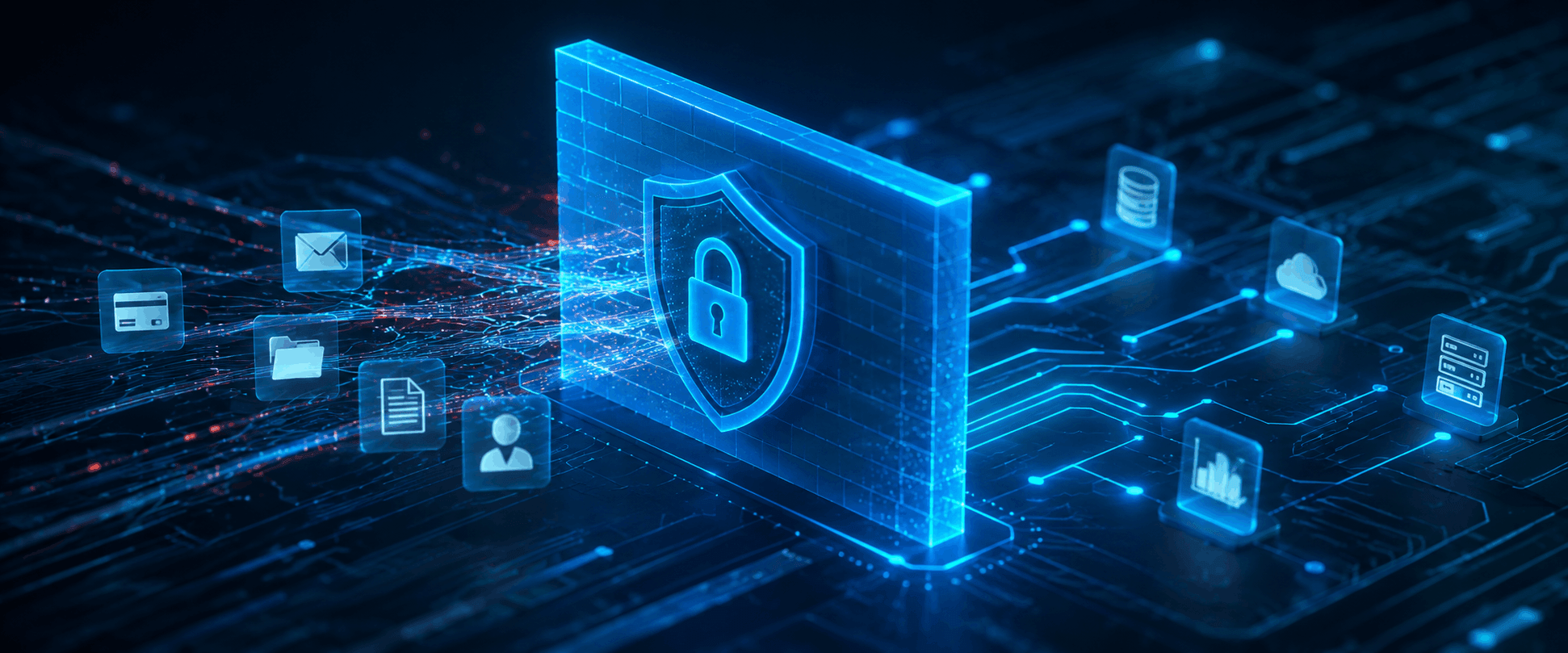
Conventional security controls were not built for this problem. A firewall that inspects network packets, an endpoint agent that scans for malware, or an identity system that manages logins has no way to evaluate whether the sentence someone just typed into ChatGPT contains a customer's medical history or a client's account number. The interaction looks like ordinary web traffic. It uses the same protocol as email or file storage. Whether the destination is a public assistant like Claude or Gemini, an enterprise copilot embedded in a productivity suite, an internal application calling a model through an API, or a retrieval-augmented generation (RAG) system pulling from a knowledge base, the exposure happens at the level of content and meaning — not at the network level where traditional tools operate. That gap is what an AI privacy firewall is built to close.
What Is an AI Privacy Firewall?
An AI privacy firewall is a policy-enforcement layer that inspects data flowing into and out of AI systems, identifies sensitive information, and applies protective action — blocking, masking, redaction, anonymization, or tokenization — before that data reaches a model or before a model's output reaches a user or downstream system.
It differs from a traditional firewall in what it inspects and how it makes decisions. A traditional firewall evaluates network-level attributes: source and destination IP addresses, ports, protocols, and known attack signatures. An AI privacy firewall evaluates content and meaning: whether a block of text contains a Social Security number, whether a document chunk retrieved by a RAG system includes a patient's diagnosis, whether an agent is about to pass a customer's payment details to an external tool. It operates at the semantic layer, not the packet layer.
Where it sits depends on the AI environment it protects. It can run at the browser or endpoint level to govern how employees use public AI tools, inside an API gateway or AI gateway to govern application traffic, inside a RAG pipeline to govern retrieved content, or inside an agent runtime to govern what autonomous systems are permitted to send to tools and external services. Wherever it sits, its job is consistent: detect sensitive data, apply a policy decision, and enforce that decision before information moves further downstream.
In one sentence: an AI privacy firewall is the inspection and enforcement layer that keeps sensitive data from reaching AI systems — or reaching users — in a form that creates unnecessary exposure.
Why AI Systems Create New Data Leakage Risks
AI systems introduce data leakage paths that did not meaningfully exist before generative AI became part of daily business workflows. Each one is a normal, sanctioned interaction rather than an intrusion.
Employee prompts. An analyst pastes a client list into a chat window to reformat it. A support agent types a customer's account details into an assistant to draft a response. Neither action looks unusual to a person watching network traffic, because it isn't — it's ordinary use of an approved tool.
Uploaded documents. Employees upload contracts, spreadsheets, and reports to AI tools for summarization or analysis. The sensitive content isn't in a prompt; it's embedded in the file itself, which most content-inspection tools were never configured to parse for this purpose.
Source code. Developers share code snippets with AI coding assistants to debug an issue or get a suggestion. That code can contain hardcoded credentials, internal API endpoints, or proprietary logic.
Customer conversations. Support and sales platforms increasingly route conversation transcripts through AI for summarization, sentiment analysis, or response drafting — carrying customer PII along with them.
RAG retrieval. A retrieval-augmented generation system pulls relevant passages from an internal knowledge base to give a model context. If document-level permissions aren't enforced upstream, retrieval can surface content the requesting user was never meant to see.
APIs. Applications call model APIs directly, often passing structured records — order histories, HR data, financial figures — as part of the request payload, with no human reviewing what's actually being sent.
AI agents and plugins. Agents that take multi-step actions may pass data between tools, APIs, and models as part of completing a task, with each hop representing a potential leakage point.
MCP tools. As organizations connect models to external systems through the Model Context Protocol, tool calls can carry sensitive parameters or return sensitive results, and that data moves through the same interaction pipeline as everything else.
Model outputs. Leakage isn't only about what goes in. A model can generate a response that includes information from its training data, from retrieved context, or from earlier turns in a conversation that shouldn't be surfaced to the current user.
Application logs. Prompts, retrieved context, and model responses are frequently stored in logs, traces, and analytics platforms for debugging and monitoring — creating a secondary copy of sensitive data outside its original system of record.
None of these examples involve an attacker. They involve normal business processes moving through channels that most existing security tooling was never built to inspect.
What Is AI Data Leakage?
AI data leakage is the unintended or unauthorized exposure of sensitive information through the use of AI systems — including exposure to the model provider, exposure to unauthorized users, or exposure through storage and logging outside the original system of record. It's useful to break it down by where in the pipeline it occurs.
User-to-model leakage
This is the most familiar path: an individual submits sensitive information directly in a prompt. It might be a full name and case number typed into a legal AI assistant, or a spreadsheet of salaries pasted into a general-purpose chatbot for reformatting
Application-to-model leakage
Enterprise applications that call model APIs on behalf of users can pass along more data than the task actually requires — full customer records instead of the specific fields needed, or entire support tickets instead of a redacted summary.
RAG leakage
A retrieval system designed to give a model useful context can just as easily surface information the requesting user isn't authorized to see, if document-level access controls aren't enforced before retrieval happens.
Agent/tool leakage
An AI agent completing a multi-step task might pass sensitive parameters to a third-party tool, an external API, or a downstream service as part of executing that task — often without a human reviewing each individual step.
Model-output leakage
A model's generated response can include sensitive information drawn from its context window, from retrieved documents, or occasionally from patterns in its training data, and that information can reach a user who shouldn't see it.
Logging leakage
Prompts, context, and responses often get written into observability and analytics systems for debugging purposes, which means sensitive data can persist in a secondary location with different access controls — or none at all — than the original system.
Understanding these paths matters because a privacy control designed for one (say, prompt inspection) does nothing to address another (say, leakage through application logs). A serious AI data leakage prevention strategy accounts for all of them.
How Does an AI Privacy Firewall Work?
At a high level, an AI privacy firewall intercepts data at the point it would otherwise flow unprotected into or out of a model, applies detection and policy logic, and only then allows the interaction to proceed. The process typically follows ten stages:
- A request or piece of data enters the AI workflow — a prompt, an uploaded document, a retrieved passage, or an agent's tool call.
- The privacy firewall intercepts that data before it reaches the model.
- Sensitive information within it is detected — names, identifiers, financial data, credentials, and so on.
- The detected data is classified according to type and sensitivity level.
- A policy engine evaluates what should happen to that specific type of data, in that specific context.
- Based on the policy, the sensitive elements are blocked, masked, redacted, anonymized, or tokenized.
- The now-safe version of the data is sent to the AI model for processing.
- When the model returns a response, that output is inspected where the policy calls for it.
- A second policy decision determines whether the output is allowed to reach the user or downstream system as-is.
- The interaction — what was detected, what action was taken, and what was allowed through — is logged for governance and audit purposes.
A simplified view of that flow:
User / Application
↓
AI Privacy Firewall
↓
Sensitive Data Detection
↓
Policy Decision
↓
Redaction / Anonymization / Tokenization
↓
AI Model
↓
Output Inspection
↓
Approved Response
Each stage matters on its own. Detection without a policy engine just produces alerts nobody acts on. A policy engine without enforcement is a document, not a control. And enforcement without output inspection leaves half the interaction unprotected — a model can still generate a response that reintroduces sensitive information even when the input side was fully sanitized.
Where Does an AI Privacy Firewall Sit?
The right architecture depends on how an organization's AI usage is actually structured. Most enterprises need more than one deployment point, because employees, applications, and agents all interact with AI differently.
Browser or endpoint. Deployed as a browser extension or endpoint agent, this position protects employees using public AI tools like ChatGPT, Claude, or Gemini directly, inspecting what they type or paste before it leaves the device.
API gateway. Positioned between an internal application and a model provider's API, this protects application-to-model traffic — the data an enterprise system sends on a user's behalf, often without any human reviewing the payload.
AI gateway. A centralized AI gateway routes all of an organization's AI traffic — across multiple applications, teams, and model providers — through a single enforcement point, making it easier to apply consistent policy at scale.
RAG layer. Positioned inside the retrieval pipeline, this protects what gets pulled from internal knowledge bases and vector databases before that content is added to a model's context.
Agent runtime. Positioned around an agent's execution environment, this governs both what an agent sends to a model and what it passes along to the tools and external systems it calls.
MCP layer. Positioned at the point where models connect to MCP servers and tools, this governs the data exposed through tool calls and tool responses.
Larger organizations typically need coverage across several of these points, because a single firewall deployed only at the browser level does nothing to protect an internal application calling a model API directly, and vice versa.