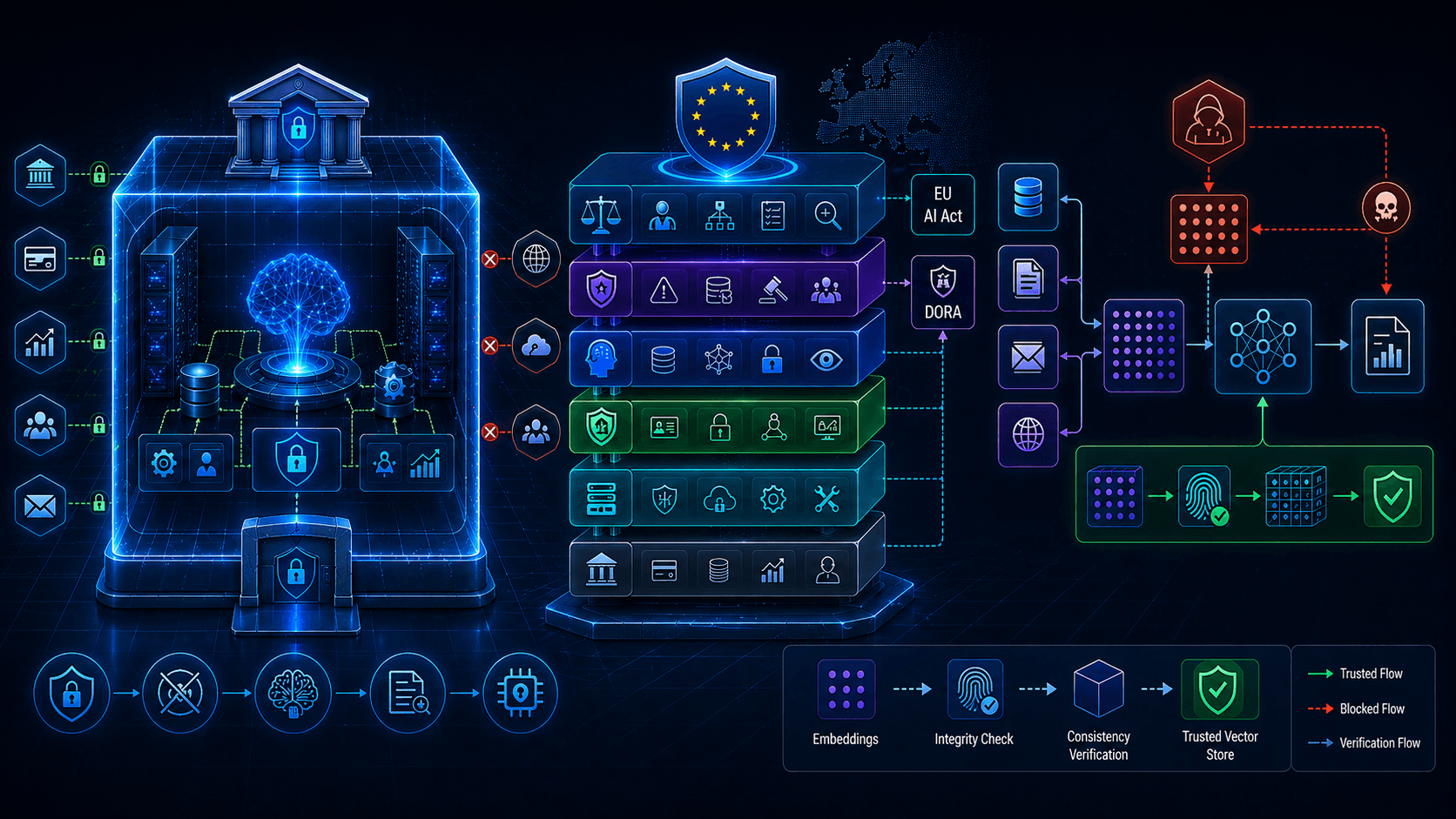
Public AI isn't automatically wrong for every use case — for low-sensitivity, non-confidential tasks, the operational simplicity can be the right trade-off. The distinction matters most where the data itself is the risk: confidential client records, financial account data, health information, or proprietary business logic. For those categories, the added control of a private or controlled architecture is usually worth the added complexity.
What Is a Privacy Data Layer in AI?
A privacy data layer is a set of controls — technical and procedural — that inspects, transforms, restricts, or governs data before and during AI processing, so that sensitive information isn't exposed to a model, a log, or a downstream system any more than the specific task actually requires.
Concretely, a privacy data layer typically handles some combination of: PII detection (identifying names, IDs, account numbers, health identifiers, and other sensitive entities in unstructured text), sensitive data classification (tagging data by sensitivity level and applicable regulatory category), data masking and redaction (removing or obscuring sensitive values), anonymization or pseudonymization where appropriate (replacing identifiers with placeholders or tokens), policy enforcement (applying rules about what data can flow to which model or destination), access controls (governing who and what can retrieve the underlying sensitive values), and logging and auditability (recording what was detected, what was done with it, and by what authorization).
It's worth being precise about what a privacy data layer does and doesn't do. It reduces unnecessary exposure of sensitive data to AI systems and the logs and infrastructure around them. It does not, by itself, guarantee regulatory compliance — compliance depends on the full set of legal, contractual, and operational controls an organization has in place, of which a privacy data layer is one component.
How Does a Privacy Data Layer Protect Enterprise AI?
The practical flow looks like this:
User or application initiates a request — a prompt, a document upload, a query against internal data. Enterprise data relevant to that request is retrieved or assembled. Privacy data layer intercepts the data before it reaches any model. PII / sensitive data detection scans the content for identifiers, financial data, health data, credentials, and other sensitive entities defined by policy. Policy decision determines what happens next based on the data type, the use case, and applicable rules — allow, mask, redact, or block. Sanitization / transformation applies the decision: sensitive values are replaced with placeholders, redacted, or otherwise transformed as policy requires. AI model / API receives only the sanitized version — enough context to perform the task, without the underlying identifiers. Controlled output is generated by the model based on that sanitized context. Audit / monitoring records what was detected, what action was taken, and — where relevant — how original values were reintroduced into the final output for authorized users.
Each stage is a separate point of control, which is precisely why this pattern is useful for demonstrating compliance rather than just asserting it: the evidence that sensitive data was handled correctly is structural (it can be shown in logs at each stage) rather than purely policy-based (a document stating the organization handles data carefully).
How Can Enterprises Prevent AI From Accessing PII?
Preventing unnecessary PII exposure to AI systems is a layered problem, not a single setting:
Identify what counts as PII for the organization's specific data — this varies by industry and jurisdiction, so the definition needs to be concrete, not generic.
Classify data by sensitivity so that different categories can be handled with different rules — a support ticket and a legal contract don't carry the same risk profile.
Minimize what reaches the model in the first place — many AI tasks don't actually require the identifying details to produce a useful result.
Sanitize or redact sensitive values before they're sent, using detection tuned to the relevant data types (names, account numbers, health identifiers, government IDs, credentials).
Enforce access policies so that even authorized users only see identifying data they're specifically permitted to see.
Restrict model permissions so that AI systems — including internally hosted ones — only have access to the data scope a given workflow actually requires.
Isolate sensitive systems so that a single compromised or misconfigured AI integration can't reach data far outside its intended purpose.
Monitor AI interactions on an ongoing basis rather than assuming a one-time review holds indefinitely.
Maintain audit trails so that if something is later flagged, there's a concrete record of what data an AI system touched, when, and under what authorization.
The right balance depends heavily on the use case. Some legitimate workflows — fraud investigation, clinical decision support, KYC verification — genuinely require controlled processing of identifiable information. The goal isn't to remove all PII everywhere; it's to ensure identifiable data only reaches an AI system when the task actually requires it, and that it's handled with appropriate controls when it does.
What Happens When Confidential Data Enters an AI System?
Confidential data that enters an AI workflow doesn't stay in one place, and each stop along the way is a separate point of risk:
Prompt — the initial input, which may contain identifiers typed or pasted directly. Model — where inference happens; depending on the provider, this may or may not be a trust boundary the organization controls. Context window — data held in active memory during a session, which can include prior turns of a conversation. Memory / session state — some AI tools persist context across sessions, extending how long sensitive data is retained. Logs — most AI platforms log prompts and outputs for debugging, quality, or (depending on settings) training purposes. Storage — where documents, transcripts, or processed outputs are saved, and under what retention policy. Vector databases — increasingly used for retrieval-augmented workflows; once sensitive data is embedded, deleting the original record doesn't always remove it from the vector store. Third-party integrations — CRMs, ticketing systems, and other connected tools that an AI agent can read from or write to. Backups — which can retain data well past the point it was deleted from the primary system.
Each of these stages carries a slightly different risk: confidentiality exposure, retention beyond what's needed, unauthorized internal access, exposure to the model provider, outright data leakage, secondary use the organization didn't intend, or cross-border processing that triggers residency obligations. A privacy-first architecture has to account for the whole path, not just the initial prompt.
Is Private AI Actually More Secure?
Private AI can improve an organization's control over its data and infrastructure — but control is not the same thing as security, and a private deployment with weak fundamentals can be less secure than a well-run public one.
Security in a private AI deployment still depends on: identity and authentication, access control (who and what can reach the model and the data behind it), encryption at rest and in transit, network security around the deployment, patching and update discipline for the infrastructure, monitoring for anomalous access or behavior, model security (protection against prompt injection and data exfiltration through the model itself), application security in whatever surfaces the model, data governance over what's classified and how, and configuration management — a private deployment that's misconfigured can expose data just as easily as a public one.
The honest answer is: private AI can be more secure, but only if the organization actually implements the controls the private deployment model makes possible. Choosing a private architecture is a necessary step for many confidential-data use cases, not a sufficient one.
AI-Powered Data Anonymization
AI-powered data anonymization uses AI techniques — primarily named entity recognition and pattern matching — to identify and transform sensitive information within text, documents, or datasets so that it can be processed with reduced identification risk.
It's worth being precise about the vocabulary, because the terms get used loosely and the differences matter legally:
Anonymization aims to remove identifying information such that the data can no longer reasonably be linked back to a specific individual. Done properly, anonymized data can fall outside the scope of certain privacy regulations — but "done properly" is a genuinely high bar, and not every technique that looks like anonymization meets it.
Pseudonymization replaces identifiers with consistent substitutes (a token, a placeholder) while retaining a mapping that allows the original values to be restored by an authorized party. Pseudonymized data is still considered personal data under most privacy frameworks, because re-identification is possible with the right key.
Masking and redaction are narrower, often permanent removals or obscurings of specific values — useful for reducing exposure in logs, screenshots, or shared documents, but not equivalent to a formal anonymization or pseudonymization process.
Synthetic data generates artificial records that preserve statistical properties of a real dataset without corresponding to any real individual — useful for testing and model development where realism matters more than fidelity to specific records.
Tokenization substitutes a sensitive value with a non-sensitive token that has no exploitable meaning on its own, with the real value stored separately and retrievable only through a controlled mapping.
AI can meaningfully assist with identifying and transforming sensitive information at scale — spotting entities across unstructured text far faster than manual review. What it can't do is guarantee that a transformed dataset is legally anonymous or that re-identification is impossible. Re-identification risk depends on how much contextual detail remains, how many other datasets could be cross-referenced against it, and how the transformation was performed. Treating "anonymized" as a permanent, irreversible guarantee — rather than a risk that has to be actively assessed — is one of the more common mistakes enterprises make with this technology.
AI Anonymization for Enterprise Data
In practice, AI-assisted anonymization and pseudonymization show up across a range of enterprise workflows: customer support (masking account and contact details before a transcript is reviewed or used to train a support assistant), analytics (allowing behavioral or transactional analysis without exposing individual identities), testing (generating realistic but non-identifying data for QA environments), AI training data preparation (reducing the identifying detail in data used to fine-tune internal models), document processing (redacting sensitive fields in contracts or records before broader internal circulation), research (enabling analysis of sensitive datasets without direct access to identifiers), and knowledge management (allowing internal search and retrieval systems to index sensitive documents while limiting what's surfaced to unauthorized users).
The recurring tension across all of these is privacy versus data utility: strip too much context and the data stops being useful for the task; strip too little and the exposure risk remains. The right balance is workflow-specific — a fraud detection model may need transaction patterns intact even while direct identifiers are masked, while a general-purpose support chatbot may need almost no identifying detail at all to do its job well.
Private AI for Financial Services
Financial services organizations handle account numbers, transaction histories, credit data, KYC and AML documentation, and internal financial models — data that is both regulated and commercially sensitive in ways few other industries match.
AI use cases in this space typically include fraud detection, compliance and AML workflow support, customer service and query handling, internal financial analysis, and document review for KYC and due diligence processes. Each of these introduces different privacy considerations: fraud detection systems often need broad access to transaction data, which makes them a high-value target for tightened access controls; compliance workflows frequently touch identity documents that carry their own regulatory handling requirements; and customer service AI needs enough account context to be useful without exposing full financial histories to every interaction.
The privacy priorities that come up repeatedly in financial services AI deployments: confidentiality of account and transaction data, strict access controls tied to role and need-to-know, data residency given the patchwork of national and regional financial regulation, third-party and subprocessor risk (a growing concern as more AI tooling is layered into existing financial infrastructure), auditability to satisfy examiners and internal risk teams, and specific regulatory obligations that vary by jurisdiction and license type. This article doesn't attempt to interpret any specific financial regulation — that's a conversation for legal and compliance counsel — but the architecture decisions above directly shape how defensible an organization's position is when those conversations happen.