Solving the "Shadow AI" Crisis
Most enterprises currently suffer from a "leaky" AI strategy. Employees use public tools to summarize internal audits or debug sensitive Python scripts, inadvertently training external models on proprietary intellectual property.
The Privacy-by-Design Fix
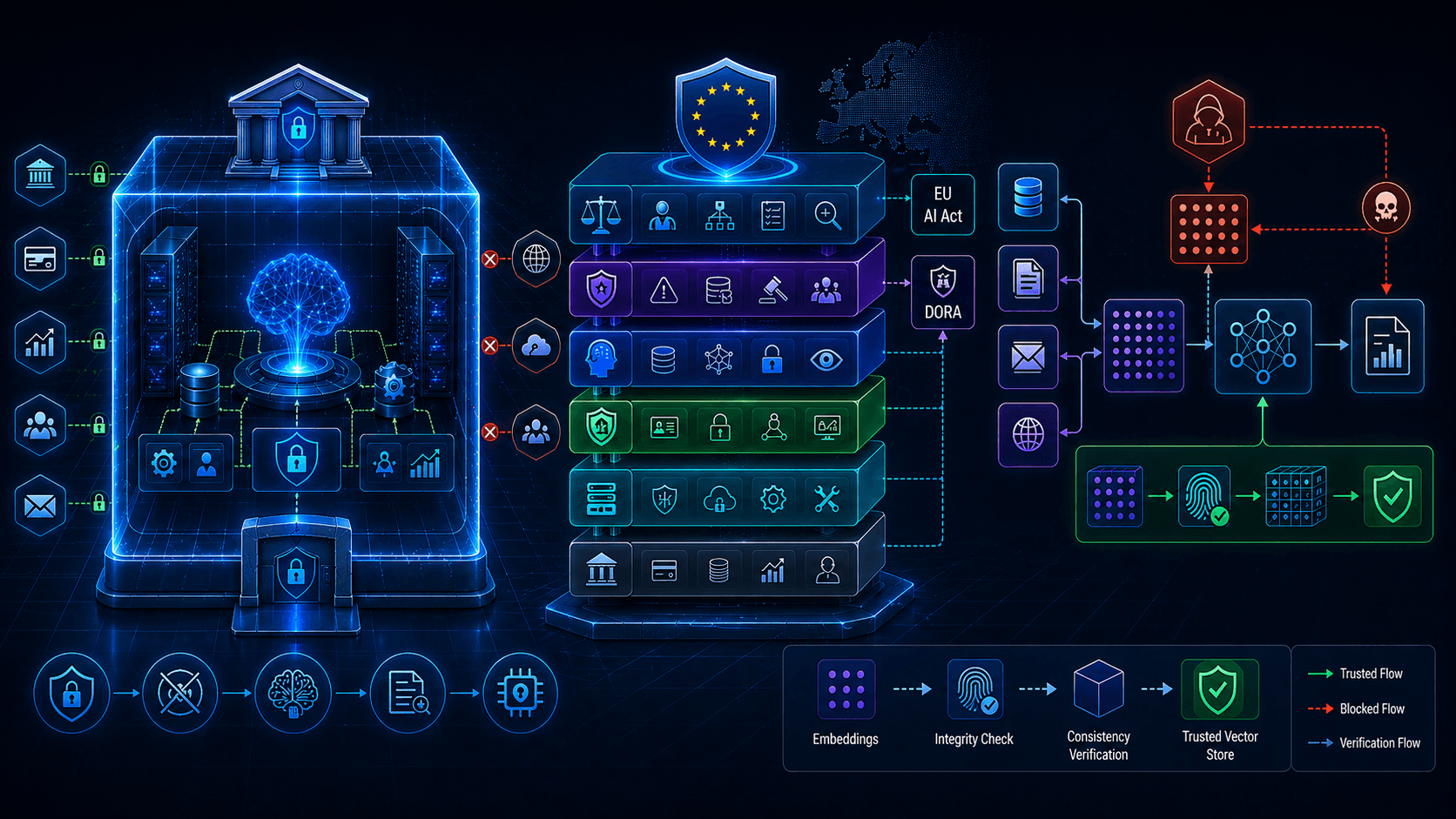
To combat this, leaders are moving toward Local-First Architectures. Instead of sending raw data to the cloud, Sovereign AI frameworks prioritize:
Local Redaction: Stripping PII (Personally Identifiable Information) before it ever leaves the local environment.
Data Anonymization: Using synthetic data or tokenization to ensure that even if a breach occurs, the data is useless to an attacker.
Privacy-First AI Agents: Specialized agents designed to execute tasks within a secure perimeter, ensuring that "Safe AI" isn't just a marketing slogan, but a technical reality.
Technical Implementation: RAG and Local Redaction
For the technical lead, the path to sovereignty often involves Agentic Retrieval-Augmented Generation (RAG) combined with local-first redaction.
By keeping the "Knowledge Base" (your private documents) on-premise or in a secure private cloud, you can utilize the reasoning power of an LLM without ever uploading your core database. At Questa AI, we’ve seen that the most resilient systems use a Python-based redaction layer that checks for license plate data, financial figures, and names before the prompt reaches the inference engine.
The Compliance Edge for Finance and MNCs
For financial institutions, the "move fast and break things" era of AI is incompatible with global regulations like GDPR or the EU AI Act. Sovereign infrastructure provides a Compliance-Ready blueprint:
Auditability: Every interaction is logged and stored internally, not on a third-party dashboard.
Encryption Architectures: End-to-end encryption ensures that even metadata is shielded from the infrastructure provider.
Geographic Sovereignty: Data stays within the required legal jurisdiction, satisfying local residency laws.
Frequently Asked Questions
What is Sovereign AI?
Sovereign AI refers to an organization's or nation's ability to develop, deploy, and govern AI systems under its own jurisdiction — using its own infrastructure, data, and workforce — rather than relying on a third-party provider's platform, terms, and policy defaults.
What's the difference between Sovereign AI and AI Sovereignty?
They're related but distinct. Sovereign AI is the technical foundation: the infrastructure, models, and compute you own and control. AI Sovereignty is the broader strategic goal: the authority over how AI systems are used, who operates them, and whether they comply with local law. Sovereign AI provides the technical means to achieve AI Sovereignty.
Does Sovereign AI mean building everything on-premise?
No. Most enterprises in 2026 adopt a hybrid model — keeping sensitive, regulated, or high-risk workloads on sovereign infrastructure while running non-sensitive tasks on public cloud. The key is classifying workloads by sensitivity first, then applying sovereignty controls where they actually matter.
Why is Sovereign AI becoming urgent in 2026 specifically?
Three converging pressures: over 140 countries now have active data protection laws (up from 80 a few years ago), the EU AI Act's high-risk obligations are taking effect, and geopolitical tensions have made governments and enterprises alike wary of strategic dependency on a handful of foreign AI providers.
What is a "sovereignty gap"?
A sovereignty gap occurs when an organization has legal control over its data but no control over the hardware or software layer where that data is actually processed — for example, using a local dataset but running it through a foreign-owned cloud inference engine. The data is "sovereign" on paper but exposed in practice.
Where does local redaction fit into a Sovereign AI strategy?
Local redaction is typically the first practical step: stripping PII and sensitive identifiers before data ever reaches an external API. It closes the most common and immediate sovereignty gap — employees inadvertently sending sensitive information to public AI tools — without requiring a full infrastructure overhaul first.
Conclusion: Reclaiming Your Intelligence
The shift toward Sovereign AI is an acknowledgment that Data is the new perimeter. Relying on "Safe AI" means building a stack that prioritizes privacy-by-design and local-first principles. By eliminating data leakage and provider lock-in, enterprises can finally move from experimental AI to mission-critical, secure implementation.
Practical Takeaways:
Audit your current "Shadow AI" usage: Map where your data is actually going.
Invest in Local Redaction: Implement a middle-layer to anonymize data before it hits an API.
Evaluate Sovereign Options: Explore local-first agents that run on-premise or in private clouds.
Ready to secure your AI future?
At Questa AI, we specialize in bridging high-level content strategy with low-level technical security. Whether you're looking for a privacy-first RAG workflow or a comprehensive content roadmap for your tech brand, our team is ready to help.
Contact the Questa AI team today to schedule a consultation on secure AI implementation and technical content strategy. Let’s build an AI infrastructure that you actually own.