One point worth being precise about, because it's easy to overstate: none of these techniques should be described as automatically or permanently achieving a legal standard like "anonymous" simply because a particular method was applied. Whether data is genuinely anonymized in the legal sense depends on the specific implementation, the auxiliary data an attacker might combine it with, and the actual risk of re-identification — not on the label attached to the technique.
PII Protection in AI Pipelines: GDPR and HIPAA Considerations
This section addresses one of the more frequent searches that leads people to this kind of guide — PII redaction techniques in logs, GDPR, HIPAA — and it's worth being precise here rather than making sweeping compliance claims, because that precision is exactly what's usually missing from this kind of content.
GDPR applies to personal data and the processing of that data within its defined scope, which includes obligations like data minimization, purpose limitation, and rights around access and erasure. HIPAA applies to protected health information (PHI) handled by covered entities and their business associates, within its own defined scope, with its own requirements around access control, audit, and safeguards for that specific category of data.
Redaction, tokenization, and related technical controls can meaningfully support the goals underlying both frameworks — data minimization is a direct requirement under GDPR, and reducing unnecessary exposure of PHI supports HIPAA's safeguard requirements. But redaction alone does not make an AI pipeline GDPR- or HIPAA-compliant. Compliance under either framework depends on a broader set of factors: whether there's a valid lawful basis for processing, how access is controlled and by whom, what retention periods apply and whether they're enforced, what contractual terms govern any third-party processors involved, what security safeguards protect the systems end to end, and how an organization demonstrates all of the above when asked.
A practical way to frame this for a compliance-minded reader: technical controls like redaction and tokenization are necessary components of a compliance program for AI systems handling personal data or PHI, but they're components — not a substitute for the broader legal and organizational work that compliance actually requires.
Can PII Appear in AI Embeddings?
Yes, and this is one of the areas where "we converted the text to vectors" gets treated as a privacy solution when it isn't automatically one.
An embedding is a numerical representation of text (or other content) produced by a model, positioned in a high-dimensional space such that semantically similar content ends up positioned near other semantically similar content. Organizations generate embeddings primarily to power retrieval — RAG systems, semantic search, recommendation — because comparing vectors is a much faster and more flexible way to find related content than keyword matching.
The privacy question is whether personal information present in the source text survives, in some recoverable form, into the resulting vector. The honest answer is: it can, to a degree that depends heavily on the embedding model, the content, and how the vector is used — and it's not something to wave away as impossible. Research on embedding inversion has shown that vector representations can retain enough information to allow partial reconstruction of meaningful content from the source text, under certain conditions. That doesn't mean every embedding of every document can be trivially reversed into the original text — the practical risk varies widely by model and use case — but it does mean the blanket assumption that vectorizing text makes the underlying information safe is not accurate, and shouldn't be the basis for a privacy decision.
Beyond the inversion question, embeddings raise a set of more conventional access-and-governance questions that are easy to overlook because a vector database doesn't look like a traditional PII store:
- Access control — who can query the vector database, and under what conditions
- Vector-store security — how the store itself is secured, including at rest and in transit
- Metadata — embeddings are frequently stored alongside metadata (source document, author, timestamp) that can itself contain or point to PII
- Deletion — whether a request to delete a person's data can actually be honored across every embedding derived from content that mentioned them
- Retention — how long embeddings persist relative to the retention policy for their source data
- Tenant isolation — in multi-tenant systems, whether one customer's embeddings are genuinely isolated from another's
- Retrieval controls — whether the retrieval layer can return content a given user shouldn't be able to see, even if the underlying embedding store has no access restrictions of its own
There's a meaningful architectural choice between removing PII before embedding — stripping or tokenizing sensitive content from a document before it's vectorized — versus embedding the PII as-is and trying to control access to the vector store afterward. When the AI workflow doesn't actually need the original PII to do its job — a RAG system answering "what's our refund policy" doesn't need customer names embedded anywhere in the knowledge base — removing it before embedding is generally the more defensible approach, because it eliminates the exposure at the source rather than relying on downstream access controls to hold indefinitely.
How Can PII Leak Through AI Outputs?
What happens when PII appears in AI outputs? It creates disclosure the organization didn't intend, through a channel that's harder to monitor than a traditional data export because the output is generated dynamically rather than pulled from a known field.
There are several distinct mechanisms worth distinguishing, because they call for different mitigations:
- Memorization — a model that was trained or fine-tuned on data containing PII can, under certain conditions, reproduce fragments of that training data in its output.
- Retrieval of sensitive information — in a RAG system, the model can surface PII that was present in retrieved documents, even if the user's query didn't ask for anything sensitive.
- Prompt or context leakage — information present earlier in a conversation or context window can resurface in later output, sometimes in unexpected combinations.
- Tool outputs — when an agent calls an external tool or API, whatever that tool returns becomes part of the pipeline's output surface, with its own PII risk.
- Data aggregation — a model combining several individually innocuous pieces of information can produce an output that, in combination, identifies someone.
- Hallucinated personal information — a model can also generate information that looks like real PII but isn't, which creates a different but still serious problem (misinformation about a real person) rather than a data-exposure problem.
- Overly broad retrieval — a RAG system configured too permissively can pull in and surface documents the requesting user shouldn't have access to at all.
- Model-generated summaries — a summarization task can inadvertently include sensitive details from source material that weren't the point of the summary but got carried along anyway.
- Mitigating this requires output inspection as a distinct pipeline stage — scanning generated content for PII before it's returned, displayed, or logged — paired with policy controls that define what should happen when detection fires: block the output, redact the specific span, flag it for review, or some combination depending on the sensitivity involved.
How Can Organizations Audit PII With AI?
"Audit PII data with AI" describes a genuinely useful and increasingly common practice: using AI-based tools to find and classify PII across systems that are too large or too unstructured for manual review to cover.
Practical applications include:
- Identifying PII across large, previously uninventoried datasets
- Inspecting logs for sensitive content that shouldn't be there
- Detecting and classifying sensitive information in unstructured documents
- Discovering PII in systems nobody had flagged as containing it — a common finding in shadow IT and legacy systems
- Monitoring for policy violations, such as sensitive data reaching a system it shouldn't
- Flagging risky model outputs for review
- Supporting broader audit and compliance workflows with searchable, classified findings
That said, AI-assisted auditing has real limitations, and treating it as infallible undermines the whole exercise. Detection accuracy varies by data type and by model, false negatives are inevitable at some rate, and context-dependent judgment calls (is this number sensitive in this particular sentence, or not) are exactly the kind of edge case automated systems handle inconsistently. Organizations using AI for PII auditing should validate detection quality against known samples, track false-positive and false-negative rates over time, and maintain human oversight for any workflow where the consequences of a missed detection are significant — a healthcare data audit and a marketing-list cleanup don't carry the same stakes, and shouldn't get the same level of unsupervised automation.
What Is PII Data Governance for AI?
PII governance, in the context of AI, is the set of policies and decisions that determine how personal data is allowed to move through AI systems — distinct from, but dependent on, the technical controls (redaction, tokenization, access management) that actually enforce those decisions.
A functioning governance program has clear answers to a specific set of questions:
- What PII is permitted to enter an AI system, and under what circumstances?
- What's the purpose it's being processed for?
- Where does it go once it enters — which systems, which stores, which logs?
- Who has access to it, and how is that access reviewed?
- How long is it retained before deletion?
- What happens to it specifically in logs?
- Can it be sent to third-party model providers, and under what terms?
- Is it permitted to enter a vector database, and if so, in what form?
- Can it appear in model outputs, and what happens if it does?
- How is it deleted — fully, across every system it touched?
- How is all of this activity audited and demonstrated after the fact?
It's worth being explicit about the distinction between governance and technical PII protection, because the two get conflated often enough that it's worth stating plainly: governance is the policy layer — the decisions about what should happen. Technical protection is the enforcement layer — the controls that make those decisions actually happen in the system. A governance policy that says "PII should never enter application logs" accomplishes nothing without a technical control at the logging layer that enforces it. Conversely, a well-built redaction pipeline deployed without any governing policy behind it tends to drift — applied inconsistently across systems, exempted for convenience, undocumented for audit purposes.
What Should an Enterprise AI Governance Policy Include for PII?
An enterprise AI governance policy that actually gets used — rather than one that sits in a shared drive and gets referenced only after an incident — tends to cover the following, in practical rather than purely legalistic language:
Approved AI use cases — which workflows are permitted to process PII through AI systems at all
Prohibited data categories — data that should never enter an AI pipeline under any circumstance, such as certain special categories of health or biometric data
PII classification standards — a shared definition of sensitivity tiers, so different teams aren't applying inconsistent judgment
Permitted processing purposes — the specific purposes PII may be used for within AI workflows
Third-party AI rules — what's allowed to be sent to external model providers, and under what contractual protections
Logging requirements — what must and must not be captured in logs, tying back to the redaction-at-capture approach covered earlier
Retention schedules — how long different categories of data persist in different systems
Redaction and tokenization standards — which technique applies to which data category and workflow type
Access control requirements — role-based access rules for systems that touch PII
Data residency requirements — where data is permitted to be processed and stored geographically
Output monitoring requirements — how model outputs get screened before they reach an end user
Incident response procedures — what happens when PII exposure is discovered, and who's responsible for what
Vendor assessment criteria — how third-party AI tools and platforms get evaluated before adoption
Audit requirements — what gets logged and reviewed to demonstrate the policy is actually being followed
Accountability — who owns each part of this, by name or role, not just by department
How to Enforce PII Policies in AI and Analytics Pipelines
Analytics pipelines process data differently than real-time AI inference — larger batches, less time-sensitivity, often less need for reversibility — but PII policy enforcement follows a similar logic, applied at a few consistent points:
Classification at ingestion. Data gets classified for sensitivity as it enters the pipeline, before any transformation or analysis touches it, so downstream steps inherit that classification rather than guessing.
Policy enforcement rules. Rules tied to that classification determine what happens next — what gets redacted, what gets aggregated only, what requires elevated access to query.
Schema-based controls. For structured analytics data, schema-level tagging (marking specific columns as sensitive) lets enforcement happen automatically rather than depending on someone remembering which fields are risky.
Data transformation. Sensitive fields get anonymized, aggregated, or tokenized as part of the pipeline itself, rather than left raw and gated only by downstream access controls.
Access controls and monitoring. Row- and column-level access restrictions determine who can query identifiable data versus aggregated data, with monitoring to catch queries that shouldn't be possible under policy.
Audit trails and retention. Every transformation and access event gets logged, and retention schedules apply consistently rather than by exception.
Downstream system governance. Whatever the analytics pipeline outputs — dashboards, reports, exports to a partner — inherits the same governance rather than starting fresh at a lower standard.
A concrete example: a retail company runs customer purchase data through an analytics pipeline to build a demand-forecasting model. Names and payment details get stripped at ingestion, replaced with a consistent customer ID that supports longitudinal analysis (this customer's purchases over time) without ever exposing who the customer actually is to the modeling team. The mapping between real identity and that ID lives in a separate, access-restricted system that only the customer-service team can query, and only for legitimate support purposes — not for analytics.
A Practical Secure AI Pipeline for PII Protection
Putting the earlier lifecycle into a single reference architecture:
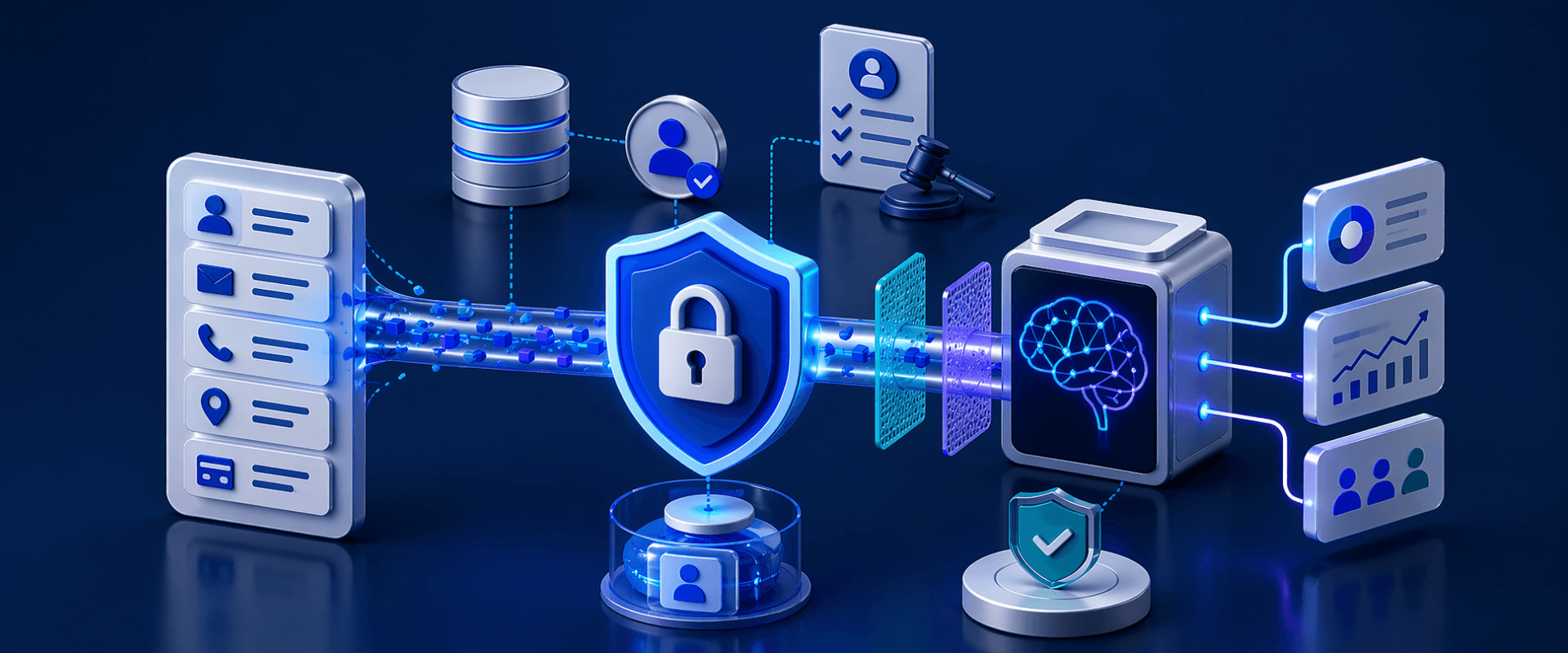
Source systems → Data classification → PII detection → Policy engine → Redaction / tokenization / pseudonymization → AI application or LLM → RAG / tool calls where required → Output inspection → Secure logging → Audit and monitoring
A few notes on how the pieces actually connect. The policy engine is the layer that ties classification and detection results to an actual decision — it's what decides, for a given piece of detected PII and a given workflow, whether to redact, tokenize, allow through, or block entirely. Without it, detection just produces a list of findings with nothing telling the system what to do about them.
RAG and tool calls sit after the model layer because retrieval and tool execution can introduce new PII into the pipeline that wasn't present in the original prompt — a retrieved document, a tool's API response — which means output inspection has to account for everything that entered the context, not just what the user originally typed.
Secure logging sits after output inspection rather than in parallel with it, because logging what was inspected and treated is more useful for audit purposes than logging raw interaction data that hasn't gone through the same controls as the rest of the pipeline.
The point worth stressing across the whole architecture: PII protection should not depend on a single control. A pipeline that relies entirely on prompt-level redaction and assumes everything downstream is therefore safe will get surprised by the first RAG retrieval, tool call, or debug log that captures data the redaction step never saw.
What to Do With PII in AI Logs: A Practical Framework
Before logging. Decide, deliberately, what actually needs to be captured for a given system to be debuggable and auditable. Most teams default to logging everything because it's the path of least resistance during development, and that default rarely gets revisited once the system reaches production.
During logging. Apply redaction or tokenization to anything unnecessary at the point of capture — not as a cleanup pass afterward. Data that's already been written to storage in raw form has already created the exposure; treating it after the fact reduces but doesn't eliminate the risk.
After logging. Control who can access the log store, how long entries persist, and what triggers a review. A well-redacted log that anyone in the company can query indefinitely still has a governance gap — it's just a smaller one than an unredacted log with the same access pattern.
During investigations. There will be legitimate cases where someone needs the original, untreated data — a security incident, a customer dispute, a regulatory inquiry. Build a defined path for that: access to original values through an authorized, logged process, rather than either blocking investigators entirely or leaving raw data broadly accessible so investigations are never blocked.
PII Protection in AI Pipelines: Enterprise Checklist
- Map every point where PII enters an AI workflow, not just the obvious one.
- Identify all downstream copies the data creates — logs, embeddings, evaluation sets, exports.
- Classify sensitive data by category and risk tier before it reaches a model.
- Define explicitly what each AI workflow actually needs, versus what it's currently receiving.
- Redact unnecessary PII before processing, rather than after.
- Tokenize data where a workflow genuinely requires reversibility.
- Protect vector stores and their metadata with the same rigor as any other PII store.
- Inspect AI outputs for unintended PII before they're returned or logged.
- Prevent raw PII from entering logs by default, not by exception.
- Apply and enforce retention policies across every system that touches the data.
- Restrict access on a role and purpose basis, not by default openness.
- Audit policy enforcement regularly, not only after something goes wrong.
- Test detection accuracy against known samples rather than assuming it's correct.
- Review third-party AI providers for what they do with data they receive.
- Maintain incident-response procedures specific to AI-related PII exposure.
How to Choose a PII Protection Solution for AI Pipelines
Rather than ranking specific products, it's more useful to lay out the questions that actually separate a solution that works in production from one that looks good in a demo.
Detection accuracy. Can it reliably identify PII in both structured fields and unstructured, free-flowing text — not just one or the other?
Context awareness. Does it distinguish sensitive information from superficially similar but harmless content, or does it flag every number and proper noun indiscriminately?
Coverage. Does it actually protect every layer discussed above — prompts, documents, logs, APIs, transcripts, RAG content, and outputs — or just the input side, which is where most tools stop?
Transformation methods. Does it support redaction, masking, tokenization, and pseudonymization, or only one technique applied uniformly regardless of whether it fits the use case?
Deployment model. Can it operate within the architecture the organization actually requires — on-premises, within a specific cloud boundary, or fully local — rather than mandating a deployment model that doesn't fit existing infrastructure?
Data handling. Does sensitive data ever leave the organization's controlled environment as part of the detection or protection process itself? A tool that has to send raw data to an external API in order to find PII in it has created a new exposure point while trying to close one.
Policy enforcement. Can different business units, data categories, or workflows apply different rules, or is enforcement all-or-nothing?
Auditability. Can security and privacy teams actually see, after the fact, what was detected, what was done about it, and who accessed what?
Integration. Does it fit into existing AI applications, APIs, and data pipelines without requiring a wholesale re-architecture?
Performance. Does it introduce latency that makes the AI workflow unusable, particularly for real-time interactions like customer-facing chat?
Governance support. Can the organization use the tool's output to actually demonstrate, to an auditor or regulator, that its policies are being enforced in practice — not just that a tool exists?
Where a Privacy Layer Fits Into Enterprise AI
Most of what's covered above describes a set of decisions an organization has to make — what to detect, what to do with it, where to enforce it. Increasingly, that work sits on a dedicated privacy layer rather than being bolted piecemeal onto individual AI applications, because building and maintaining detection, policy enforcement, and audit tooling separately for every AI workflow doesn't scale past a handful of use cases.
Questa AI is built around that idea — anonymizing sensitive data locally, before it reaches a model, rather than trying to control exposure after the fact. The underlying approach detects personal, financial, health, and other sensitive entities in documents, transcripts, and other content, and replaces them with placeholder values before that content is sent to an LLM, whether the model is hosted internally or by a third party. A governance dashboard sits alongside that anonymization layer, tracking what was detected and redacted, which gives a privacy or security team something concrete to point to when they need to demonstrate that a policy is actually being enforced rather than just written down.
The practical value of this kind of layer is narrower and more specific than "solving compliance" — it addresses the technical-control layer this guide has spent most of its length on: reducing unnecessary PII exposure before AI processing, keeping the mapping between real identities and placeholder values inside a controlled boundary, and giving a governance team visibility into what's actually happening across AI workflows rather than having to trust that each individual application was built correctly. It supports a broader compliance and privacy program; it isn't a substitute for the legal, contractual, and organizational work that program still requires.
Enterprise Use Cases
Customer support AI. A support ticket comes in with a customer's name, account number, and details of a disputed transaction. Before the ticket reaches a summarization model, the account number and name get replaced with placeholder tokens; the model produces its summary against the anonymized version, and the original values are only reintroduced for the human agent who needs them to actually resolve the ticket.
Banking AI assistant. A banking assistant fields customer questions about balances, transactions, and account details. Policy determines what data actually reaches the model — often nothing beyond what's needed to answer the specific question asked — and what gets logged for compliance purposes, which is treated separately and more restrictively than what the model itself sees.
Healthcare AI. A clinical documentation workflow processes patient notes containing diagnoses, medications, and identifying details. Purpose-based processing matters heavily here — what a clinical-summary tool needs is different from what a billing-code-suggestion tool needs, even when they're drawing on the same underlying record — and the applicable privacy and security requirements around PHI shape what controls are non-negotiable versus what can flex by use case.
HR AI. Employee documents — performance reviews, compensation details, medical accommodation requests — often contain sensitive personal information that an AI tool analyzing broader HR trends doesn't actually need at the individual level. Fields unnecessary for a given analysis get protected before the document enters the pipeline, rather than relying on the analysis itself to somehow ignore what it was given.
RAG knowledge base. An enterprise builds a RAG system over internal documents — contracts, project files, meeting notes — some of which contain personal data about employees or customers. Before those documents get embedded, the pipeline needs to decide what belongs in the vector store at all, apply redaction or tokenization to what shouldn't be there in raw form, and enforce retrieval controls so the system doesn't surface personal details to users who have no legitimate reason to see them.