How Does a Privacy Layer Protect Confidential Business Data?
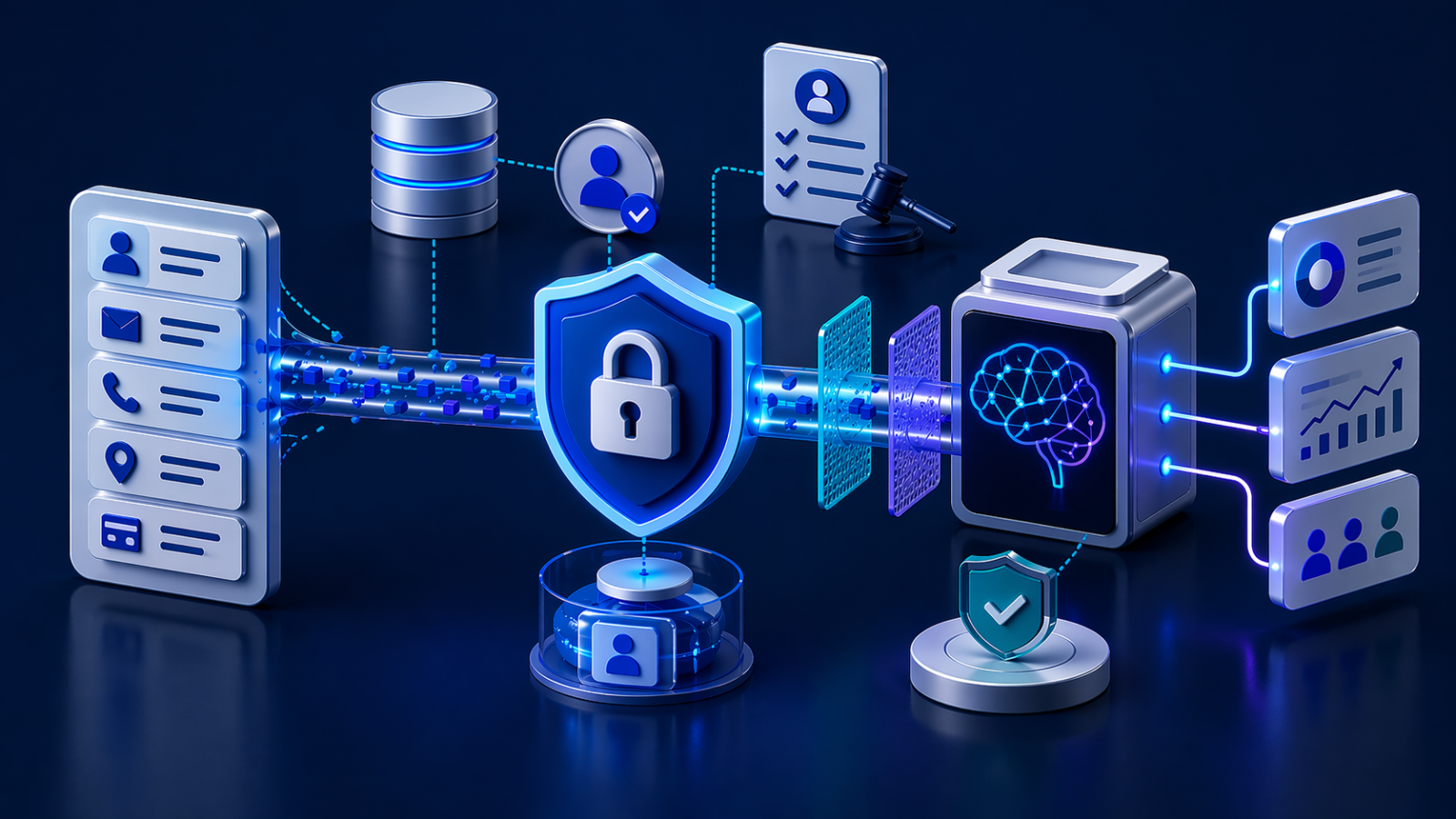
A privacy layer protects confidential business data by sitting between the business's users or applications and the AI model, detecting sensitive content and applying protection before that content reaches the model, then reversing or reconciling protection on the way back. The architecture typically looks like this:
User or application submits a request → the privacy layer detects confidential data in that request → protection (anonymization, masking, or similar) is applied → the protected version is sent to the AI model → the model's response returns through the privacy layer → the response is reconciled or reunified as needed → the authorized user or application receives the final result.
The location of this layer matters. If it sits at the browser or endpoint level, it governs how employees interact with public AI tools directly. If it sits inside an API gateway, it governs traffic between internal applications and AI providers. If it sits inside a RAG AI pipeline, it governs what retrieved document content actually reaches the model. If it sits inside an agent runtime, it governs what an autonomous AI agent is permitted to read, send, or act on.
Placing protection at the point where data would otherwise leave the business's control, rather than relying on policy or employee training alone, is the practical difference between hoping sensitive data isn't exposed and actually preventing that exposure by design.
How Should Businesses Use AI With Customer and Client Data?
Businesses handling customer or client data should apply AI to tasks that do not require raw identifiers whenever possible, and protect that data before it reaches an AI system when identifiers are unavoidable. The specifics vary by sector.
In customer support and BPO settings, AI is often used to summarize tickets, suggest responses, or route inquiries. Call transcripts and chat logs frequently contain account numbers, addresses, and sometimes payment details. Protecting these fields before an AI model processes a transcript allows the AI to still understand the customer's issue and sentiment without exposing the specific identifiers.
SaaS platforms embedding AI features into their own products face a layered problem: their own customers' data is passing through both the SaaS platform and, often, a third-party model provider. Being explicit with end customers about this data flow, and giving them meaningful control over it, has become a common expectation in enterprise SaaS procurement.
Financial services firms working with AI on client portfolios, KYC checks, or fraud review need to consider that financial identifiers are often subject to sector-specific regulation in addition to general privacy law, and that AI-assisted decisions affecting a client's account may carry additional disclosure obligations.
Healthcare organizations using AI to support clinical documentation or claims processing need to treat patient identifiers as protected health information, which typically requires specific contractual protections (such as a business associate agreement in the US) with any AI vendor touching that data.
Legal services firms using AI to review contracts or case files need to weigh privilege and confidentiality obligations that may not apply to other industries, meaning some AI use cases might be appropriate for internal, non-privileged documents but not for privileged client communications.
How Can Businesses Use AI With Confidential Documents?
Businesses can use AI with confidential documents by identifying which fields or sections within a document are sensitive, protecting those specific parts, and only then allowing the AI to process the full document for tasks like summarization, extraction, or classification. Document-processing AI introduces risk not because documents are inherently dangerous to process, but because a single document, such as a contract, an invoice, or a financial report, often mixes sensitive and non-sensitive content in the same file.
A contract might combine boilerplate legal language (low sensitivity) with specific deal terms, signatory names, and payment details (high sensitivity). An invoice pairs a vendor name and line-item description with a bank account number. An internal report might mix general commentary with a specific employee's performance data.
Reducing unnecessary exposure in document workflows usually involves detecting sensitive fields at the document level, applying protection to those fields specifically rather than to the whole document indiscriminately, and preserving enough surrounding context so the AI can still complete tasks like clause extraction, anomaly detection, or summarization accurately. Where a business processes large volumes of similar documents, such as thousands of invoices or contracts, building this detection and protection step into the document pipeline itself is generally more reliable than depending on manual review before each AI task.
What Should Businesses Check Before Using a Third-Party AI Provider?
Before sending confidential data to a third-party AI provider, businesses should confirm where data is processed and stored, whether it is used for model training, how long it is retained, who can access it, and what happens to it when the contract ends. A structured evaluation should cover:
- Where is data processed, and in which country or region?
- Where is data stored, and for how long?
- Is customer input used to train or fine-tune the provider's models, and can this be disabled?
- How long are prompts and responses retained, both in active systems and backups?
- Who at the provider can access submitted data, and under what circumstances?
- What subprocessors or downstream vendors are involved in handling the data?
- Can the business control or restrict processing locations and methods contractually?
- Are regional or in-country processing options available for regulatory reasons?
- What happens to logs generated during processing?
- What happens to backups when data is deleted?
- What is the data deletion process when the contract ends or a specific request is made?
- Can sensitive data be protected (anonymized, masked, or similar) before it reaches the provider at all?
- What deployment options exist, such as shared cloud, dedicated instance, or on-premises?
This is not a substitute for a full AI vendor due diligence or procurement process, but it is the minimum set of questions specific to confidential data handling that should be answered before any sensitive information is submitted to a new AI provider.
What Are the Best Practices for Using AI With Confidential Data?
The most effective practices group into a few connected areas rather than a long, undifferentiated checklist.
Reduce what reaches the AI system. Minimize data before processing, and separate the step of detecting and protecting sensitive information from the step of AI inference, so the model only ever sees what it actually needs.
Control who can act on results. Restrict access to AI outputs based on role, and manage retention so that prompts, responses, and logs don't persist longer than necessary on either the business's or the provider's side.
Choose vendors deliberately. Evaluate AI providers against the specific criteria above before onboarding them for sensitive workloads, and revisit that evaluation when a provider changes its terms or subprocessors.
Verify the protection actually works. Test privacy controls against real samples of the business's own data rather than assuming default configuration is sufficient, since detection accuracy varies by data type and context.
Treat this as ongoing, not one-time. Review AI workflows regularly, especially as new AI features get added to existing software or new data sources get connected to AI agents, since exposure often creeps in through small changes rather than one big decision.
AI With Confidential Data in Regulated Industries
Financial services, healthcare, insurance, legal, and BPO organizations generally face stricter expectations around confidential data in AI workflows because the information they handle, and the harm from its exposure, is more consequential and often specifically regulated. It's worth being precise about what "stricter" means in each case, because legal requirements, industry practice, and technical best practice are not the same thing.
Legal requirements are what specific laws or regulations actually mandate: HIPAA's Security Rule and Business Associate Agreement requirements for protected health information in the US, or GDPR's data protection principles for personal data processed in the EU. Industry practices are conventions that have become common within a sector even where not strictly mandated, such as many financial institutions treating any AI use touching client portfolios as requiring dedicated risk review. Technical best practices are the engineering and architectural approaches, such as anonymization or private deployment, that support compliance but do not by themselves guarantee it.
No single technique makes an organization automatically compliant with a given law. Anonymizing data before it reaches an AI model reduces risk and can support a compliance argument, but whether a specific AI use case satisfies GDPR, HIPAA, or another framework depends on the full context: the legal basis for processing, the contractual terms with the AI vendor, the specific data involved, and how the output is used. Businesses in regulated industries should treat technical controls as one part of a broader compliance program, not a replacement for legal review.
How Questa AI Helps Businesses Use AI With Sensitive Data
Questa AI positions itself around this specific problem: protecting sensitive information before it reaches an AI system, rather than trying to control what happens after the fact. Its core function is anonymizing confidential business data, such as personal identifiers, financial details, and proprietary content, before that data is processed by an AI model, whether the AI runs in the cloud or on the business's own infrastructure.
This sits directly on the workflow described earlier in this article: identifying sensitive information, protecting it, and controlling what actually reaches an external AI provider. Questa AI's product line includes options for self-hosted deployment inside a business's own network, an API for embedding privacy protection into existing applications, and a version aimed at smaller teams who want to query their own business data with AI without building this infrastructure themselves. The company also offers flexibility in which underlying AI model processes the protected data, rather than tying customers to a single provider.
The relevance to this article isn't that a privacy layer is the only way to use AI safely with confidential data. Minimization, careful vendor selection, and access controls all matter regardless of tooling. A dedicated privacy layer becomes relevant specifically when a business needs to apply protection consistently and automatically across many documents, users, or workflows, rather than depending on individual employees to remember to remove sensitive details before every AI interaction.