We haven't included specific latency, cost, or accuracy percentages here, because those figures vary significantly by dataset, implementation, and workload — any benchmark you see quoted should specify exactly what was tested before you rely on it.
GraphRAG vs Vector RAG: What Questions Does Each Handle Best?
The clearest way to see the difference is through examples.
Vector RAG example: "What does our supplier contract say about termination?" This is a direct lookup — the answer sits in a specific contract clause. Semantic search can find the relevant passage efficiently, without needing to understand how that supplier relates to anything else.
GraphRAG example: "Which suppliers are connected to contracts affected by this regulatory change?" Answering this requires following a chain: regulation → the contract clauses it affects → the contracts containing those clauses → the suppliers tied to those contracts. That's a relationship traversal, not a single semantic match — the kind of question GraphRAG's graph structure is built to handle.
Hybrid example: "Which suppliers are affected by the new regulation, which contracts are involved, and what do those contracts say about termination?" This question has both a relational component (which suppliers and contracts are connected to the regulation) and a semantic component (what the termination clauses actually say). A hybrid approach can use graph traversal to identify the relevant suppliers and contracts, then use vector search to retrieve and summarize the specific clause language within those documents — combining relationship-aware narrowing with semantic precision.
When Should You Use Vector RAG?
Vector RAG is often the better choice when:
- Questions are primarily semantic lookups against a defined set of documents
- You're building internal knowledge bases, FAQ systems, or document Q&A tools
- Content covers policies, procedures, contracts, or support documentation
- Your underlying content changes frequently and needs to stay easy to re-index
- Deployment speed and operational simplicity matter more than handling complex relationship queries
- Relationships between entities aren't central to how users actually ask questions
None of this makes Vector RAG a lesser architecture — for a large share of enterprise RAG use cases, it's the right tool, and adding graph infrastructure would be unnecessary overhead.
When Should You Use GraphRAG?
GraphRAG's added complexity is more likely to be justified when:
- Questions routinely require multi-hop reasoning across entities
- Your domain is inherently relationship-heavy: supply chains, corporate ownership structures, financial networks
- You're supporting fraud investigation or anomaly detection, where connections between entities are the signal
- Compliance and regulatory mapping require tracing how a rule, product, or vendor connects across the business
- Legal or scientific research workflows depend on synthesizing evidence across many documents
- Analysts currently manually stitch together information from multiple sources to answer a single question
If your team can point to real recurring questions that fit this pattern, GraphRAG is worth evaluating seriously. If those questions are rare, the extraction and maintenance overhead may not pay for itself.
When Should You Use Hybrid RAG?
Hybrid retrieval combines vector search and graph retrieval rather than forcing a single choice. Vector search provides broad semantic recall; graph retrieval adds relationship-aware context where it's needed. In practice, this doesn't mean running both systems on every query — a routing or orchestration layer can classify incoming questions and decide whether graph traversal is warranted, falling back to vector search (or using both) as appropriate.
This pattern is becoming more common as teams recognize that most enterprise question sets are mixed: some queries are simple lookups, others are genuinely relational. But hybrid retrieval isn't automatically the right answer for every organization — it adds its own orchestration and evaluation complexity, and it only pays off if you actually have a meaningful volume of both query types.
GraphRAG vs Vector RAG: Cost and Complexity
Vector RAG has a comparatively simple pipeline: chunk, embed, index, retrieve. Each step is well-understood, and there's a mature ecosystem of tooling around it.
GraphRAG's pipeline has more stages, each of which introduces its own cost and failure modes:
- Entity extraction (often LLM-based, which adds inference cost)
- Relationship extraction and validation
- Graph construction and schema/ontology design
- Ongoing graph updates as source documents change
- Community detection and summarization, in implementations that use it
- Additional infrastructure for graph storage and traversal
- Additional monitoring to catch extraction drift or graph quality issues over time
We won't cite a universal cost multiplier here — claims like "GraphRAG costs 3x" or "10x" more than Vector RAG depend entirely on the specific implementation, document volume, and workload, and should be treated skeptically unless tied to a named benchmark with clear methodology. The more useful question for your organization is: does the retrieval improvement on your actual queries justify the additional engineering and operating cost? That's answerable through evaluation on your own data, not through generic industry claims.
GraphRAG Limitations
The case for GraphRAG is real, but it comes with trade-offs that are easy to underweight.
Higher implementation complexity. Building a working graph pipeline requires more design decisions and more moving infrastructure than standing up a vector index.
Entity and relationship extraction quality. GraphRAG is only as good as its extraction step. Incorrect or missed entity and relationship extraction propagates directly into incorrect graph structure — and, downstream, into wrong or misleading answers that can look structurally well-supported even when they aren't.
Ontology and schema challenges. Different domains need different graph structures. A schema designed for supply-chain relationships won't necessarily generalize to legal or financial relationships, and getting this wrong early can require significant rework later.
Maintenance overhead. Source documents change. Every update requires re-running extraction, validating new relationships, and keeping the graph consistent — a heavier and more error-prone process than re-embedding a changed document. Without active maintenance, a knowledge graph can drift out of sync with the underlying source of truth faster than a vector index does.
For balance: Vector RAG's own limitation is the mirror image of this — it can miss relationship-dependent answers not because the information isn't retrievable, but because similarity search alone doesn't model connections. That gap is addressable with added techniques, but it's a real limitation worth naming rather than glossing over.
How to Evaluate GraphRAG vs Vector RAG for Your Organization
Rather than choosing an architecture based on which one is generating more buzz, a more defensible process looks like this:
- Audit real query patterns. Pull actual or representative questions your users ask (or would ask) of the system. Tag them as single-hop/semantic or multi-hop/relational.
- Estimate the mix. If the large majority are semantic lookups, Vector RAG alone may be sufficient. If a meaningful share are relational, GraphRAG or hybrid retrieval deserves a pilot.
- Pilot on a narrow, representative dataset, not your entire corpus. This surfaces extraction quality issues early, before they're expensive to fix.
- Evaluate against your own queries, using retrieval precision/recall and end-to-end answer quality — not generic public benchmarks, which may not reflect your domain.
- Weigh ongoing maintenance capacity, not just build cost. A graph that isn't maintained degrades in ways that are harder to detect than a stale vector index.
- Reassess periodically. Query patterns shift as an organization's use of the system matures; the right architecture today may not be the right one in a year.
Where Data Privacy and Security Fit Into the Decision
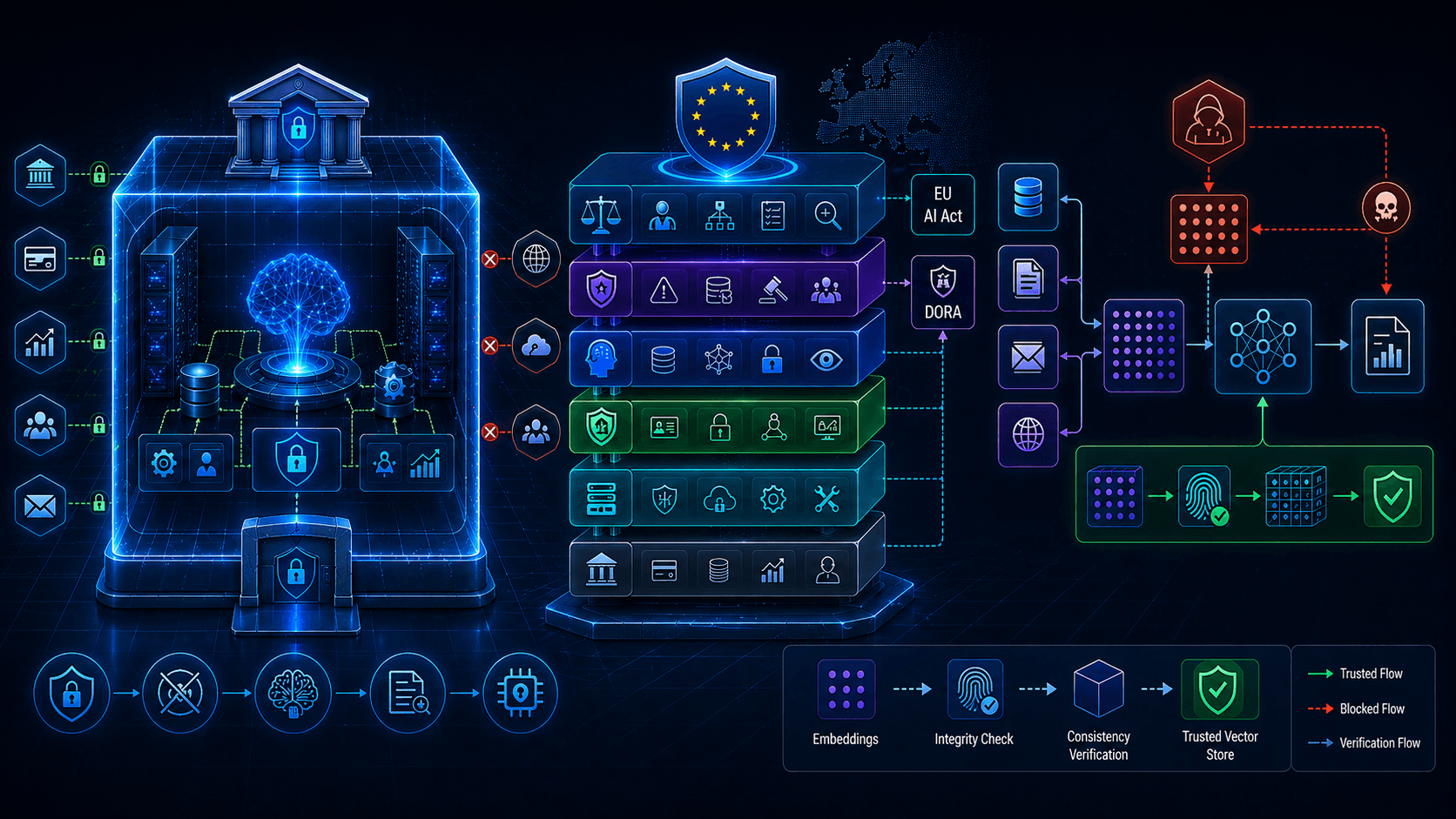
Architecture choice isn't just about retrieval accuracy — for regulated or security-conscious organizations, it also touches how sensitive data is extracted, stored, and accessed. GraphRAG in particular introduces new surfaces to think about: entity extraction pipelines that process raw documents, a graph structure that may make relationships between sensitive entities more explicit and more queryable than they were in unstructured text, and additional infrastructure that needs its own access controls and audit trails.
This is where Questa AI's approach is built to be a meaningful differentiator rather than a marketing claim: enterprise deployments — whether Vector RAG, GraphRAG, or hybrid — are designed with data governance as a first-class requirement, including control over what gets extracted into a graph, how relationships involving sensitive entities are access-controlled, and how retrieval activity is logged for audit purposes. The architectural decision (Vector RAG vs. GraphRAG vs. hybrid) should be made on retrieval fit first; privacy and security controls should then be applied consistently regardless of which architecture you land on.