JUN 24, 2026Updated Sep 16, 2026
Enterprise AI Data Access Governance: Monitor & Audit
A recent legal analysis of AI-accelerated vulnerability discovery got boards asking sharp questions about external AI threats. But the question most security and privacy teams are quietly less prepared to answer is closer to home: what can the AI systems running inside our own business actually access, who authorized that, and can we prove it? That's not a policy question — it's an operational one, and it's the subject of this guide.

Controlling AI access to sensitive data requires several controls working together, not one product or policy. Organizations need identity and authentication to establish who or what is making a request; authorization and least-privilege policies to define what that identity may retrieve; data classification so sensitivity is known before access is granted; retrieval-time permission checks so access is enforced at the moment data is requested, not only when it was first indexed; and monitoring, logging and audit trails so the organization can reconstruct what happened afterward. The AI model itself should never be the thing deciding whether a request is authorized — that decision belongs to deterministic application and security controls sitting outside the model.
What Is AI Data Access Governance?
AI data access governance is the set of controls an organization uses to define, enforce, monitor and prove what its AI systems and AI agents are permitted to access. It sits at the intersection of identity and access management, data classification, and AI-specific monitoring, and it treats every AI system — chatbot, RAG pipeline, coding assistant, autonomous agent — as a principal that needs the same access discipline applied to any human user or service account.
The practical difference between AI data access governance and a general AI usage policy is enforcement. A policy tells employees what they should and shouldn't do. AI Governance is the infrastructure that makes unauthorized access harder to happen in the first place, and that produces evidence when it's asked to.
How AI Systems Actually Access Enterprise Data
A lot of the anxiety here rests on an inaccurate assumption: that connecting AI to a data source means it can now see everything in it. That isn't automatically true, and it isn't automatically false — what the AI can reach depends on the application's architecture, the credentials it was given, and whether enforcement happens at the right point in the pipeline.
AI applications commonly reach enterprise data through:
- Enterprise search and RAG systems that index documents, wikis, and knowledge bases and retrieve relevant passages at query time
- Vector databases storing embeddings generated from that indexed content
- Document repositories such as SharePoint, Google Drive, Confluence, or a DMS
- CRM and ERP systems holding customer, sales, and financial records
- Transactional databases accessed directly or through a data warehouse
- SaaS applications and their APIs, often through OAuth-scoped integrations
- Cloud storage buckets connected via service accounts
- Internal knowledge bases and wikis used to ground assistant responses
- Email and document integrations that let an assistant read or draft on a user's behalf
- AI agents, tools, and plugins/connectors that let a model take actions, not just read
The general flow looks like this: a user or a triggering event initiates a request, the AI application authenticates that request against an identity, an authorization layer determines what that identity is allowed to retrieve, a retrieval or tool-calling step pulls the actual data, that data enters the model's context window, and the model produces an output — which may itself trigger a tool call into another system.
Access-control failures tend to cluster around two points in that flow: the authorization step, when permissions are checked against a stale or overly broad policy instead of the current one, and the retrieval step, when the system pulls information without re-verifying that the requesting identity is still allowed to see it. A model that behaves perfectly can still return unauthorized information if the layer feeding it data got the access decision wrong.
Authentication vs. Authorization vs. Monitoring vs. Audit
One of the most common gaps in enterprise AI governance is treating these four controls as roughly interchangeable. They aren't, and confusing them is how organizations end up with, say, strong authentication and no audit trail, or extensive logging and no actual enforcement of who's allowed to see what.
| Control | Question It Answers |
|---|---|
| Authentication | Who — or what system — is requesting access? |
| Authorization | What is that identity allowed to access? |
| Data classification | How sensitive is the requested information? |
| Policy enforcement | Should this specific request be allowed, right now? |
| Monitoring | What actually happened? |
| Audit evidence | Can the organization reconstruct and prove what happened, later, to a third party? |
Each of these can fail independently. An organization can authenticate every AI request perfectly and still have no authorization policy governing what an authenticated identity can retrieve. It can have a solid authorization policy and no monitoring, meaning violations go undetected. It can monitor extensively and still lack audit evidence, because monitoring data was never structured in a way that connects a request to a retrieval to an output. Each layer has to be built and verified on its own terms.
How Do You Prove an AI System Only Accessed Authorized Data?
This is, in practice, one of the hardest questions security and privacy teams are being asked — by auditors, by regulators, by their own boards — and "we have RBAC" is not an answer to it. Role-based access control tells you what's supposed to happen. It doesn't tell you what actually happened when an AI system made a specific request at a specific time. Proving authorized access requires evidence spanning the entire path data took, from the identity that initiated the request through to what the AI ultimately did with the information.
| Evidence | What It Proves |
|---|---|
| User/agent identity | Who or what initiated the request |
| Authorization policy in effect | What access was permitted at that moment |
| Data classification | The sensitivity of the requested data |
| Access decision (allow/deny) | Why the request was allowed or denied |
| Retrieval log | What data was actually pulled, not just what was theoretically accessible |
| Document/data source ID | Which specific source or record was accessed |
| Model/application trace | What content actually entered the model's context window |
| Tool/API call log | Which downstream systems the AI contacted, and with what parameters |
| Output record | What the system returned to the user or downstream process |
| Audit trail linking the above | Whether the entire event can be reconstructed end to end |
The distinction that matters here is between permission and enforcement. An organization can have a correct, well-designed RBAC policy on paper and still have no evidence that the policy was actually checked at the moment an AI system retrieved a specific document. Proving authorized access means the retrieval log and the authorization decision have to be tied together, not maintained as separate, unconnected systems.
How to Audit AI Access to Company Data
An AI access audit is not a single scan. It's a methodology, and it needs to be repeatable, because permissions, connected systems, and deployed AI tools all change continuously.
- Inventory AI applications and AI agents. List every AI system in production use — approved assistants, embedded AI features inside SaaS tools, internal RAG applications, and agentic workflows. Include features vendors turned on by default inside platforms already licensed; these are easy to miss because no one explicitly "deployed" them.
- Map connected data sources. For each system, document exactly which databases, repositories, SaaS applications, APIs, and vector stores it can reach. Distinguish what it's technically capable of reaching from what it's supposed to reach — the gap between those two lists is where risk concentrates.
- Identify human and machine identities. Every AI system operates under some identity — delegated user permissions, a shared service account, an API key, or a dedicated agent identity. Shared service accounts are a particular red flag, since they make it impossible to attribute a specific access event to a specific requester.
- Map permissions and authorization policies. Document what each identity is authorized to access and under what conditions. Check whether policies reflect current org structure or are inherited from a setup that predates the current use case — permissions reasonable at initial configuration often stop being reasonable as usage expands.
- Classify sensitive data. Confirm the data these AI systems can reach has actually been classified — PII, financial records, health information, credentials, privileged legal material, confidential business information. Without classification, "sensitive data access" can only be guessed at, not measured.
- Review retrieval and access events. Pull actual logs of what was retrieved, not just what was permitted. This is where authorization theory meets operational reality — a policy that looks correct on paper can still be bypassed by a misconfigured connector or an overly broad service account.
- Test least-privilege boundaries. Deliberately test whether a system can be prompted into retrieving data outside its intended scope, whether an agent can chain a legitimate tool call into an unintended one, and whether retrieval-time checks re-verify permissions rather than trusting a cached decision.
- Monitor for anomalous access patterns. Watch for AI systems retrieving unusually large volumes of data, reaching outside their normal pattern, or being queried in ways that suggest an attempt to enumerate what's accessible — the AI equivalent of user behavior analytics.
- Preserve evidence and review continuously. Access reviews shouldn't be annual events. Connected sources change, new agents get deployed, and permissions drift — build a retention and review cadence that can answer an auditor's question about an event from six months ago, not just last week.
What Should an AI Data Access Monitoring Tool Do?
Enterprise teams searching for tools in this space are often looking for a single product that does everything. In practice, these capabilities are frequently delivered across several layers of the security and governance stack — identity, data governance, DLP, and AI-specific observability — rather than by one tool alone. What matters during evaluation is whether the combination of tools an organization has actually covers the following capabilities, not which vendor's logo is on which one.
AI discovery — identifying AI applications, embedded assistants, and agents actually operating across the environment, including ones never formally provisioned.
Data-source visibility — enumerating which repositories, databases, SaaS systems, and APIs are connected to each AI system.
Identity mapping — tying every access event to a specific human user, service account, workload identity, or AI agent, rather than a generic application-level credential.
Authorization enforcement — policies that actually determine, at the point of a request, what an AI system is permitted to retrieve.
Retrieval-time controls — permissions checked when information is requested, not only when it was first indexed; one of the most consequential gaps in RAG deployments, covered below.
Sensitive-data detection — recognizing PII, financial data, health information, credentials, and confidential business information as it moves through the pipeline.
Monitoring — visibility into unusual retrieval or access patterns as they occur, not just after the fact.
Audit trails — the ability to reconstruct exactly what was requested, what was retrieved, why access was permitted, and what happened afterward.
Policy violation detection — identifying attempts, successful or not, to access information outside the permitted scope.
Reporting — evidence that security, privacy, compliance, and leadership can each pull from the same underlying records.
Procurement conversations go better when they start from this capability list rather than a feature comparison, because it forces a real answer to "does this actually enforce anything, or does it just observe."
Why AI Agents Make Data Access More Difficult
An AI assistant answers a question. An AI agent does something with the answer — and that difference changes the entire access-control problem.
A typical agent workflow looks like: retrieve information, reason over it, call a tool, use that tool to access another system, retrieve additional information from that system, and then produce an output or take an action. Each step in that chain is a separate access event, and each one needs its own authorization check. The security question stops being "can this AI read the data" and becomes: what data can this agent retrieve, under whose authority, through which tools, and for what stated purpose?
This is harder to govern for a specific set of reasons:
- Excessive permissions, provisioned because scoping per workflow is harder than granting broad access
- Inherited permissions, where an agent launched on a user's behalf inherits that user's full access instead of a task-scoped subset
- Stale permissions left over from an earlier version of a workflow
- Shared service accounts that make it impossible to attribute a specific action to a specific agent instance
- Tool/API access that extends beyond the original request — an agent asked to summarize a document may technically be able to modify or delete it too
- Cross-system data access, combining sources in ways no single system's access controls anticipated
- RAG retrieval and vector database permissions, covered in the next section
- Agent and machine identity management that hasn't caught up to how these systems are deployed
- Authorization boundaries that stop at the tool level rather than the data level — a tool being "allowed" doesn't mean every argument passed to it should be
- Auditability gaps, where a multi-step action produces one log line instead of a traceable sequence
An agent should not be treated as trustworthy simply because the person who launched it happens to have broad access themselves. The Model Context Protocol governance discipline that's emerging in enterprise environments distinguishes between user-delegated access, where permissions should vary by the initiating user, and machine-to-machine access, where a consistent, tightly scoped set of permissions applies at the agent level — and conflating the two is a common source of over-permissioning.
RAG Creates a Specific Authorization Problem
RAG is not inherently insecure, but it does change the architecture in ways that create new places for authorization to fail — this is often misunderstood as "RAG bypasses permissions," which isn't accurate. The real flow is: source document permissions exist at the document level, documents get chunked and embedded into a vector store, and a query retrieves the chunks most semantically relevant to it. The risk lives in what happens — or doesn't — to those permissions along that path.
OWASP's guidance on securing retrieval-augmented generation systems identifies this as one of the most common compliance failures in production RAG deployments: access control metadata attached to a source document has to carry through to every chunk derived from it, not just live at the document level. When permissions are checked once, at ingestion, and never re-verified at retrieval time, a permission change made after ingestion — an employee losing access to a folder, say — simply doesn't take effect. The vector store keeps returning chunks from documents the requester is no longer supposed to see, because nothing in the retrieval path checks current permissions against the request.
The practical safeguards mirror that diagnosis directly: store access-control metadata — classification, owner, permitted roles or tenants — alongside every vector chunk, not just the parent document; enforce authorization checks at retrieval time rather than trusting whatever was true at indexing time; maintain hard tenant isolation in shared vector stores so one tenant's query structurally cannot surface another tenant's chunks; and log every retrieval with both the requester's identity and the access-control metadata of what was actually returned, since that log is what makes a compliance audit possible after the fact.
AWS's guidance on this same problem is direct on one point in particular: an LLM should be treated as an untrusted entity for authorization purposes, because it doesn't implement access control as part of generating a response, and any data placed into a prompt should be assumed to be something the requesting principal could see returned to them. That's the technical basis for the broader principle running through this whole article — authorization decisions belong outside the model, enforced by the application and identity layer, not delegated to the model's judgment.
Monitoring Is Not the Same as Prevention
These get conflated constantly, and the distinction matters for how an organization actually architects its controls.
Monitoring tells you what happened. It's observational. A strong monitoring layer can tell a security team, after the fact, that an AI agent retrieved a document it shouldn't have.
Authorization determines what is allowed. It's the policy layer that defines the boundary in the first place.
Policy enforcement is what actually blocks or permits the action in real time, based on the authorization policy.
Audit evidence demonstrates what happened and whether the other three layers actually operated as intended — it's the record that lets someone outside the system verify all of this after the fact.
An organization with excellent monitoring and weak enforcement will have a very complete record of unauthorized access events it didn't prevent. That's a real improvement over having no visibility at all, but it's not the same as having access control. NIST's 2026 research on post-deployment monitoring of AI systems underscores a related point relevant here: monitoring practices, tooling, and even shared terminology for this space are still immature across the industry, and the relationship between monitoring and auditing remains an open question the field hasn't fully settled. That's a reasonable caution against treating any single monitoring product as a complete governance solution.
Protecting Sensitive Data Beyond Access Control
There's a second question sitting underneath most of what's been covered so far, and it's easy to skip past: even when access is correctly authorized, does the AI actually need the sensitive information in fully identifiable form to do its job?
These are genuinely different questions. Access control answers: is this principal allowed to access the information? Data minimization and privacy protection answer: does the AI need the sensitive information in this specific form to complete the task?
A customer service assistant summarizing a support ticket may be fully authorized to access the customer's account — but the task at hand might not require the model to see a full unredacted record when a subset of fields, or a masked version of the sensitive ones, would accomplish the same outcome. Passing an entire customer record into a model context when the task only needs the shipping status is exposure the access-control layer alone won't catch, because from an authorization standpoint, nothing is wrong: the request was permitted.
Techniques that address this second question — masking, redaction, pseudonymization, and other privacy-preserving transformations applied before data reaches a model — sit alongside access control rather than replacing it. An organization can have airtight authorization and still be sending more identifiable data into model context windows than any given task requires. This is where a dedicated privacy layer in the architecture earns its place: not as a substitute for authorization, but as the control that answers a question authorization was never designed to answer.
AI Data Access in Regulated Industries
The query patterns coming into this topic make clear that regulated industries are asking a slightly different version of this question: how do you get value from AI recommendations without exposing the sensitive data underneath them?
Financial services organizations manage customer records, transaction data, credit information, and confidential business data across use cases from fraud detection to advisory tools, and typically face the strictest access-control and audit expectations of any sector in scope here.
Healthcare organizations work with patient and clinical information where an AI system's ability to prove what it accessed — and what it didn't need to — is often the difference between a defensible deployment and an indefensible one.
Legal organizations handle privileged documents and confidential case material, where even internal, authorized access to the wrong matter's files can create conflict-of-interest problems unrelated to any external attacker.
BPO and customer operations teams handle client-owned data across multiple client relationships at once, which makes tenant isolation — the same principle covered in the RAG section above — a first-order concern rather than an edge case.
HR functions manage employee, applicant, and compensation data where access boundaries typically need to be tighter than general business data.
No single deployment model — cloud, on-premise, or otherwise — automatically satisfies a regulatory requirement on its own. What regulated organizations generally need to demonstrate is a combination of controls: access control, data minimization, monitoring, accountability for decisions, auditability of what happened, defined retention practices, an incident response process, and diligence over vendor controls where third-party AI is involved. Encryption, DLP, and RBAC are each part of that picture — none of them, alone, constitutes the whole of it.
Enterprise AI Data Access Control Architecture
A practical way to think about the full path data travels, end to end:
User / Employee
↓
Identity & Authentication
↓
Authorization / Policy Engine
↓
AI Application or Agent
↓
Data Retrieval / Tool Layer
↓
Sensitive Data Controls
↓
Approved Data Only
↓
Model / LLM
↓
Output Validation
↓
Monitoring + Audit Trail
Identity & authentication establishes who or what is making the request. Authorization / policy engine determines what that identity is permitted to access, evaluated against current policy rather than a cached decision. The AI application or agent executes the task but doesn't decide what it's allowed to touch. Data retrieval / tool layer is where the actual request happens, and where retrieval-time checks belong. Sensitive data controls apply classification, masking, or redaction before information proceeds — the data-minimization layer covered above. Approved data only reaches the next stage; everything upstream exists to make that true. The model receives context that's already filtered and minimized rather than being asked to make the authorization call itself. Output validation checks what the model produced before it reaches the user or triggers a downstream action. Monitoring and audit trail run underneath every layer, capturing what happened at each step so the chain can be reconstructed later.
The organizing principle across every layer: the model can request information, but the surrounding application and policy infrastructure decides whether that request gets fulfilled. Never the reverse.
10 Questions to Ask Before Giving AI Access to Sensitive Data
Useful as a working checklist for security reviews and AI procurement:
- What data, specifically, can this AI system access — not what it could theoretically reach, but what it's actually scoped to?
- Which users, service accounts, or agents can initiate access through it?
- How are permissions enforced — is there a policy engine, or is access effectively open once a connection is made?
- Are permissions checked at retrieval time, or only when data was first indexed?
- Can access be scoped to the minimum data required for the specific task?
- Can AI agents call tools or APIs that extend beyond the scope of the original request?
- Are sensitive data types detected and classified before they're processed?
- Are retrieval events and tool calls logged, not just top-level user interactions?
- Can the organization reconstruct a specific AI data-access event end to end, on demand?
- What happens to indexed or cached data when a user's permissions change or are revoked?
Warning Signs Your AI Data Access Controls Are Too Weak
- AI applications authenticate using shared credentials rather than individually attributable identities
- Permissions are inherited once at setup and never rechecked as roles or scopes change
- The vector database doesn't preserve document-level access-control metadata on individual chunks
- Security teams can't determine which specific documents or records an agent retrieved for a given task
- Tool calls and API requests made by an agent aren't logged with the same rigor as top-level chat interactions
- Audit records exist in silos and can't be linked from user → request → retrieval → output
- Sensitive data is passed into model context in full, identifiable form by default, with no minimization step
- Access decisions depend, in practice, on the model's own judgment rather than a deterministic policy check
- Revoking a user's access doesn't stop previously indexed data from continuing to surface in retrieval results
- No individual or team is accountable for AI access governance specifically — it falls between IAM, data governance, and AI/ML teams without clearly belonging to any of them
How a Privacy Layer Fits Into the Architecture
Access control and AI data privacy solve adjacent but distinct problems, and a mature architecture treats them as complementary layers rather than choosing one over the other. Authorization determines whether a request should be fulfilled at all. A privacy layer determines what form the data should take once a request has been approved — whether the full record needs to move into a model's context, or whether a minimized, masked, or pseudonymized version accomplishes the same task with less exposure.
This is where a platform Questa AI fits into the broader picture described in this article. Questa AI is positioned as a privacy and data-protection layer inside an enterprise AI architecture — detecting sensitive data, applying anonymization or redaction, and supporting privacy-protected AI workflows that reduce how much identifiable information needs to reach a model in the first place. It's not a replacement for identity and access management, and it doesn't make authorization decisions on its own; that layer has to be handled by the organization's IAM and policy infrastructure, as described throughout this article. What a privacy layer adds is the second question this article has tried to keep distinct from the first: given that access is authorized, does the task actually require the sensitive information in identifiable form.
How Questa AI Can Help Protect Sensitive Data in AI Workflows
Organizations building out AI data access governance are typically assembling several categories of control at once — identity and authorization from their existing IAM stack, monitoring and audit infrastructure purpose-built for AI interactions, and a privacy layer that reduces unnecessary exposure of sensitive data before it reaches a model. Questa AI's role sits in that last category: helping teams detect sensitive data moving through AI pipelines, apply data anonymization and redaction where appropriate, and maintain the kind of protected-data workflows that make it easier to demonstrate data minimization alongside access control.
None of this replaces the authorization and monitoring work described earlier in this article. A privacy-protection layer and an access-control layer answer different questions, and an enterprise generally needs a credible answer to both before it can claim its AI systems are properly governed.
Frequently Asked Questions
It depends on the application's architecture, credentials, and enforcement mechanisms. Connecting an AI system to a data source doesn't automatically mean it can see everything in it, but it also doesn't guarantee proper scoping happened — which is why explicit authorization and retrieval-time enforcement matter.
Effective monitoring requires purpose-built logging of AI-specific events — retrieval requests, tool calls, and data returned to the model — tied to a specific identity. Traditional DLP and SIEM tools weren't built to inspect this kind of activity, so AI-aware logging needs to sit alongside them.
Start with an inventory of AI applications and agents, map the data sources each one can reach, identify the identities operating them, and review actual retrieval logs against the authorization policies meant to govern them. A full methodology is covered earlier in this article.
You need connected evidence spanning identity, authorization decision, data classification, retrieval logs, and what actually entered the model's context — not just a policy document describing what should have happened. "We have RBAC" describes intent; a linked audit trail describes what occurred.
The set of controls an organization uses to define, enforce, monitor, and prove what its AI systems and agents are permitted to access — combining identity and access management, data classification, and AI-specific monitoring into one discipline.
The process of determining what a specific identity — human, service account, or agent — is permitted to access or do through an AI system, enforced by policy controls outside the model rather than left to the model's own judgment.
It combines authentication (verifying who's making a request), authorization (determining what they're allowed to access), and enforcement (applying that decision at retrieval or action) — rechecked at each request rather than relying on a permission decision made once, earlier.
By scoping the agent's identity and credentials to the minimum required for its task, enforcing authorization at each tool call and retrieval rather than only at launch, and logging every step of a multi-part action so it can be audited individually.
Treat each step of an agent's workflow — retrieval, reasoning, tool call, further retrieval, action — as its own access event requiring a log entry, then review whether the agent's actual behavior stayed within its intended permission scope.
Access-control metadata from source documents needs to be preserved at the chunk level in the vector store, and permissions need to be checked again at retrieval time rather than trusted from ingestion, since a permission change made after indexing won't take effect otherwise.
At minimum: discover AI applications and agents in use, map connected data sources, tie access events to specific identities, enforce authorization at retrieval time, detect sensitive data types, and produce audit trails that reconstruct a full request-to-output chain.
No — monitoring tells you what happened after the fact; it doesn't decide what's allowed to happen. Prevention requires authorization and policy enforcement operating alongside monitoring, not monitoring as a standalone control.
Through access control (limiting who and what can retrieve the data) combined with data minimization (limiting how much identifiable information the AI actually receives) — masking, redaction, and pseudonymization address the second question, not the first.
Beyond access control, regulated organizations typically need to demonstrate data minimization, monitoring, accountability for access decisions, auditability, defined retention practices, an incident response process, and diligence over any third-party AI vendors involved.
Access control determines whether an identity is permitted to retrieve certain data at all. Data privacy and minimization determine whether the AI actually needs that data in fully identifiable form to complete its task — an authorized request can still expose more than necessary without minimization.
Conclusion
There's a specific standard an enterprise should be able to meet, and it's worth stating plainly rather than as a vague aspiration. For any AI system operating on company data, the organization should be able to answer: who accessed the data, what data the AI actually accessed, why access was allowed, whether that access stayed within policy, what specifically entered the model's context, what tools or downstream systems the AI interacted with, what evidence remains to reconstruct the event later, and whether the same task could have been completed with less sensitive information in the first place.
Meeting that standard doesn't come from a single tool or a single policy document. It comes from authorization enforced outside the model, retrieval-time checks that hold up even as permissions change, monitoring that catches what enforcement misses, audit trails that connect the whole chain together, and a privacy layer that minimizes exposure even when access is properly authorized. Access governance and privacy protection are both necessary here — neither one, by itself, is sufficient.

About the author:
Abhiroop Sharma
Ex. Distinguished technology leader
Distinguished technology leader with 18+ years of progressive experience spanning AI, Web3, SaaS, eCommerce, and blockchain governance. Demonstrated success in driving digital transformation across global markets, with expertise in scaling enterprise solutions from concept to implementation. Proven track record of reducing implementation timelines by 50% and building high-performing teams across multiple organizations. Currently focused on pioneering AI implementation and Web3 integration strategies for emerging technology ventures.
Related Articles

JUN 23, 2026
Privacy Cafe
Enterprise AI Monitoring: See What AI Does With Data
Enterprise AI monitoring covers what AI tools access, how agents handle company data, and what EU AI Act and Australian privacy rules require of security teams.
Read More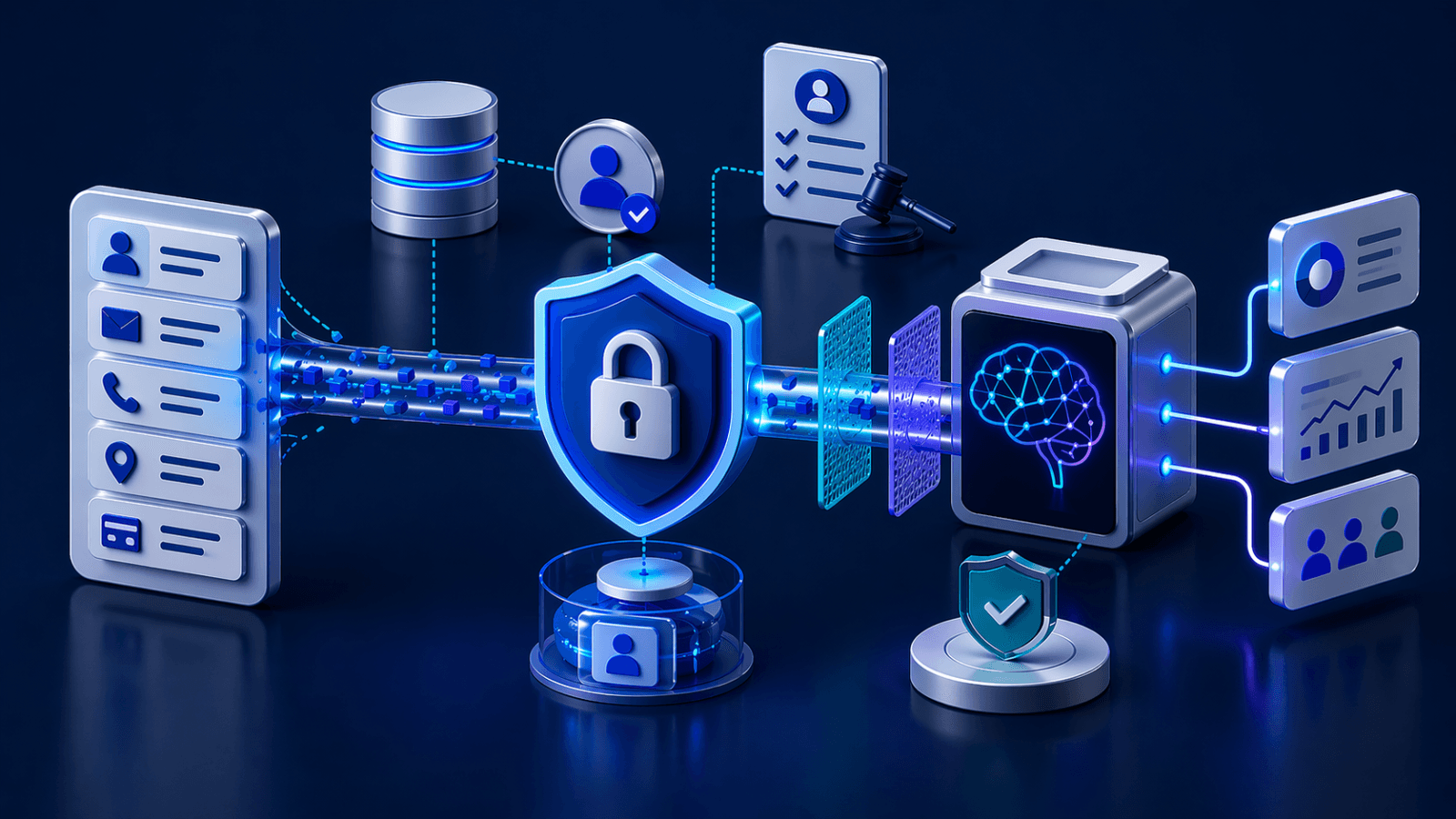
APR 21, 2026
Privacy Cafe
How to Protect PII in AI Pipelines: A Practical Guide
PII moves through AI pipelines in ways most governance programs miss — prompts, logs, embeddings, outputs. Here's what actually protects it, GDPR to HIPAA.
Read More
APR 03, 2026
Privacy Cafe
AI Model Routing: Balancing Cost, Quality & Privacy
A practical guide to AI model routing — how enterprises weigh cost, capability, privacy, and data residency to choose the right model for each task.
Read More